
Deep Sleep vs REM Sleep: Which One Matters More for Recovery?

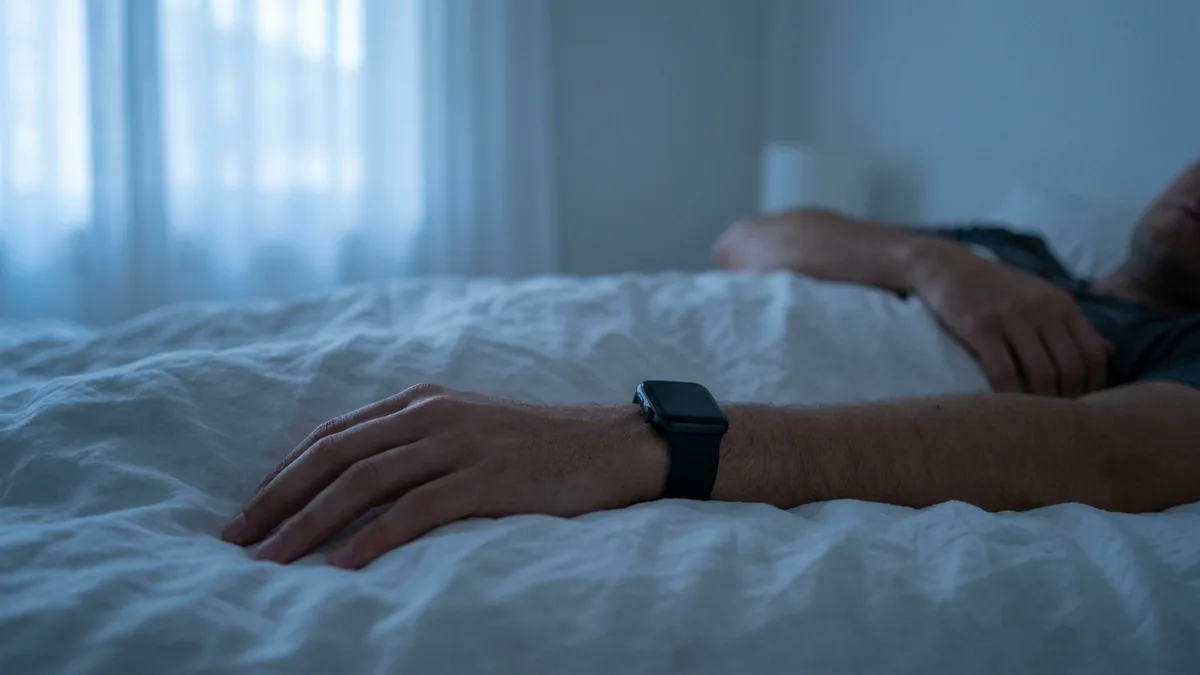
You check your sleep app in the morning and see the breakdown: 1h 12m deep, 1h 38m REM, the rest in light. One number is green, the other is yellow. Which one actually matters?
It's one of the most-asked questions about sleep tracking — and the answer isn't what most people assume. Deep sleep and REM sleep aren't competing. They do completely different jobs, and you need both.
Here's what each stage actually does, how much you really need, and why ignoring either one costs you more than you think.
The Four Sleep Stages in 60 Seconds
Your brain cycles through four distinct stages every 90–110 minutes across the night:
- Stage 1 (light sleep): The drift-off phase. Lasts a few minutes.
- Stage 2 (light sleep): Where you spend most of the night — around 45–55% of total sleep.
- Stage 3 (deep sleep / slow-wave sleep): The physical repair stage.
- REM sleep (rapid eye movement): The dreaming stage. Your brain is almost as active as when you're awake; your body is paralyzed.
Most deep sleep happens in the first third of the night. Most REM sleep happens in the last third. That's why cutting sleep short on the morning end costs you REM, and going to bed too late costs you deep sleep. You can't catch up on one by sleeping in — timing matters.
What Deep Sleep Actually Does
Deep sleep is your body's physical maintenance window. While you're in it:
- Growth hormone peaks. Up to 75% of your daily growth hormone releases in deep sleep. This is when muscle repair, bone remodeling, and tissue healing happen.
- Your immune system consolidates. Immune cells are produced and "trained" on the pathogens your body encountered during the day.
- Cerebrospinal fluid flushes your brain. The glymphatic system — discovered in 2013 — clears metabolic waste including beta-amyloid, the protein linked to Alzheimer's. This only happens in deep sleep.
- Heart rate and blood pressure drop to their lowest levels of the 24-hour cycle, giving your cardiovascular system a genuine rest.
Deep sleep is why you wake up feeling physically restored. Miss it, and you'll feel stiff, sore, and run-down even if you slept a full eight hours.
The people most affected by deep sleep loss: athletes (impaired recovery and performance), anyone sick or recovering from illness, and adults over 40 (deep sleep naturally declines with age).
What REM Sleep Actually Does
REM sleep is your brain's mental maintenance window. It's the opposite of deep sleep — your body is still, but your brain is on fire.
- Memory consolidation. REM is where yesterday's experiences get filed into long-term memory. A 2010 Harvard study showed people who got full REM remembered learned tasks 20% better than those who were deprived of it.
- Emotional processing. REM sleep is when the emotional charge on difficult memories gets turned down. This is why a problem that felt crushing last night often feels smaller in the morning.
- Creativity and pattern-matching. REM is when your brain finds non-obvious connections between ideas. "Sleeping on it" is real — and it's REM doing the work.
- Skill learning. Physical and cognitive skills get encoded deeper during REM. Musicians, athletes, and language learners all benefit disproportionately from REM.
Miss REM and you won't feel physically bad — you'll feel mentally foggy, emotionally fragile, and less creative. It's a subtler deficit but just as real.
Which One Matters More?
Neither. They serve completely different functions, and you need both — in roughly equal amounts.
Asking "which is more important" is like asking whether your heart or your lungs is more important. They do different jobs. Miss enough of either one and you break.
But here's the nuance: in the short term, deep sleep loss is more immediately noticeable (you feel physically wrecked). REM loss is sneakier — you don't feel it acutely, but cognitive performance, mood, and memory all decay quietly.
Long-term studies link chronic deep sleep deficits to cardiovascular disease and cognitive decline. Chronic REM deficits are linked to depression, anxiety, and impaired memory (Psychology Today, 2022).
📱 Livity shows you exactly how much deep and REM sleep you're getting each night, straight from your Apple Watch — no subscription, no extra hardware. Try it free →
How Much Deep Sleep and REM Do You Really Need?
For a healthy adult on a 7–9 hour night, target ranges are:
- Deep sleep: 13–23% of total sleep — roughly 60–110 minutes for most people
- REM sleep: 20–25% of total sleep — roughly 90–120 minutes
- Light sleep: 45–55% — everything else
Those numbers come from polysomnography studies in healthy adults (Sleep Foundation).
A few realities most articles don't mention:
These numbers shift with age. After 40, deep sleep naturally drops by 2–5% per decade. By 65, getting 60 minutes of deep sleep is excellent. Don't panic if your numbers look lower than your 25-year-old self's.
Consumer wearables are approximations. Oura's sleep staging is ~79% accurate vs. clinical polysomnography. Apple Watch is a bit lower. The direction and trend are reliable; the exact minutes are not.
Cycles matter more than totals. Each 90-minute sleep cycle contains both deep and REM. Four full cycles > five broken ones, even at the same total duration.
Signs You're Not Getting Enough of Either
Signs you're low on deep sleep:
- Waking up stiff, sore, or physically unrefreshed
- Slow recovery from workouts
- Getting sick more often than usual
- Elevated resting heart rate (your body is working overnight)
- Low HRV on your wearable
Signs you're low on REM:
- Brain fog that doesn't lift after coffee
- Emotional over-reaction to small things
- Trouble retaining new information
- Lack of dream recall for weeks
- Feeling "wired but tired" mid-afternoon
If both are low, you're probably just sleeping too little overall. The stages come with duration.
How to Get More Deep Sleep and REM
The good news: the same habits that boost one usually boost the other. The priority order:
1. Cool your room. 18–19°C (65–67°F) is the research-backed sweet spot for deep sleep. Warm rooms suppress both stages but crush deep sleep hardest.
2. Go to bed earlier (not later). Since deep sleep clusters in the first half of the night, shaving an hour off the front end costs you disproportionately more deep sleep than shaving an hour off the back.
3. Protect your morning. REM clusters in the last third of your sleep. An alarm two hours earlier than usual can cost you half your REM for that night. This is why "sleep in on weekends" actually helps REM recover.
4. Cut alcohol. Alcohol crushes REM sleep specifically. A 2018 meta-analysis found even moderate drinking (1–2 drinks) reduced REM by 15–30%. Deep sleep takes a smaller hit.
5. Get 30 minutes of morning light. This anchors your circadian rhythm, which directly improves the timing and depth of both stages.
6. Stop eating 2–3 hours before bed. Digestion keeps your body warm and sympathetic-dominant, suppressing both deep and REM.
7. Train — but not too late. Exercise increases deep sleep, but high-intensity training within 2–3 hours of bed can delay REM onset.
You don't need perfect execution. Pick the two worst offenders for you and fix those first.

Frequently Asked Questions
What happens if I don't get enough REM sleep? Short-term: brain fog, poor memory retention, emotional reactivity. Long-term: higher risk of depression, anxiety, and cognitive decline. REM is cumulative — you can't skip it every night without consequences.
What happens if I don't get enough deep sleep? Slower physical recovery, weaker immune function, stiffness, and over time, elevated risk of cardiovascular disease and metabolic issues like insulin resistance.
Can you have too much deep sleep or REM? Rarely an issue in healthy adults. Excess deep sleep sometimes signals recovery from illness or sleep debt. Excess REM can point to sleep disorders or certain medications — but these are edge cases.
How accurate is my Apple Watch at tracking sleep stages? Modern Apple Watches hit roughly 73–78% accuracy on sleep stage classification compared to clinical tests. Good enough for trends, not good enough for medical diagnosis. See how accurate your sleep tracker really is.
Do naps count for deep sleep or REM? A 20–30 minute nap is almost entirely light sleep. A 90-minute nap contains one full cycle with both deep and REM — that's why longer naps feel more restorative.
The Bottom Line
Deep sleep is your body's repair shift. REM sleep is your brain's repair shift. They happen in different parts of the night, do different jobs, and both are non-negotiable for recovery.
Stop asking which one is more important. Ask instead: am I getting enough total sleep, at consistent times, in a cool dark room? If the answer is yes, both stages will usually take care of themselves.
Start Tracking Your Sleep Stages Today
You can't improve what you don't measure. Seeing your deep and REM numbers night after night is what makes the difference between "I think I slept okay" and "I know exactly where my sleep is weak."
Livity breaks down your deep sleep, REM, and light sleep every morning — automatically from your Apple Watch. No Oura Ring, no Whoop strap, no subscription. Free to try on the App Store.

iOS developer with 7+ years of experience and an active volleyball player. Built Livity after spending months looking for advanced recovery and sleep tracking that worked natively with Apple Watch — and finding nothing. Uses his own HRV, sleep, and training-load data every day to shape what Livity measures.
Daugiau šio autoriaus straipsniųPradėkite savo sveikatos kelionę šiandien
Gyvenkite geriausiai
Prisijunkite prie tūkstančių naudotojų, kurie jau stebi sveikatą su Livity.