
What Is HRV? Heart Rate Variability Explained

Your heart rate might be 60 bpm, but your heart isn't beating exactly once per second. The tiny gaps between beats fluctuate constantly — and that fluctuation is called heart rate variability (HRV). It's one of the most revealing signals your body gives you, and most people have never heard of it.
What Is Heart Rate Variability?
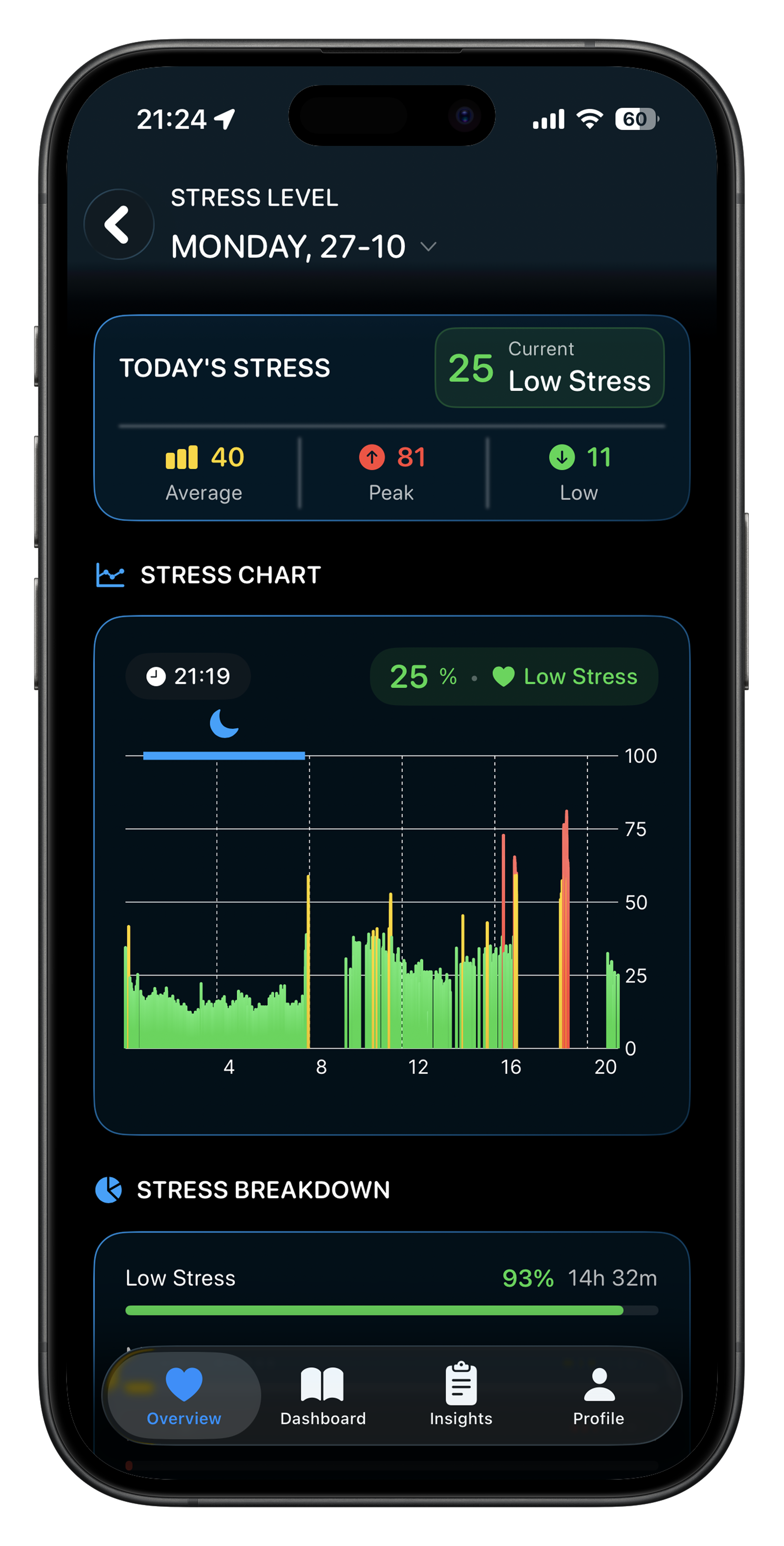 Livity tracks HRV and stress directly from your Apple Watch — no extra hardware needed.
HRV is the variation in time between consecutive heartbeats, measured in milliseconds. If your heart rate is 60 bpm, it's not beating once every 1,000ms on the dot — it might beat at 950ms, then 1,050ms, then 980ms. That constant fluctuation is your HRV.
This variation is driven by your autonomic nervous system (ANS) — the system that controls heart rate, breathing, digestion, and stress response without you thinking about it. The ANS has two branches:
- Sympathetic nervous system — your "fight or flight" mode. Speeds up your heart in response to stress, danger, or exertion.
- Parasympathetic nervous system — your "rest and digest" mode. Slows your heart and promotes recovery.
When these two systems are in balance and communicating actively, your HRV is higher. When stress, poor sleep, illness, or overtraining tip the balance, your HRV drops.
What HRV Actually Tells You
HRV is a window into your nervous system. A single measurement means little — what matters is your personal baseline and how it changes day to day.
A drop in your HRV can signal:
- Incomplete recovery from hard training
- Poor sleep quality
- Illness or immune stress
- High psychological stress
- Alcohol consumption
A sustained higher HRV trend over weeks reflects:
- Improving cardiovascular fitness
- Better sleep habits
- Effective stress management
Research published in Frontiers in Cardiovascular Medicine (2025) found that reduced resting HRV — specifically SDNN below 70ms — is associated with a 1.5 to 2.3x higher risk of major adverse cardiovascular events. That's not a reason to panic. It is a reason to pay attention.
📱 Livity turns your Apple Watch HRV data into a daily recovery score and real-time stress level — no extra hardware needed. Try it free →
What's a Good HRV Score?
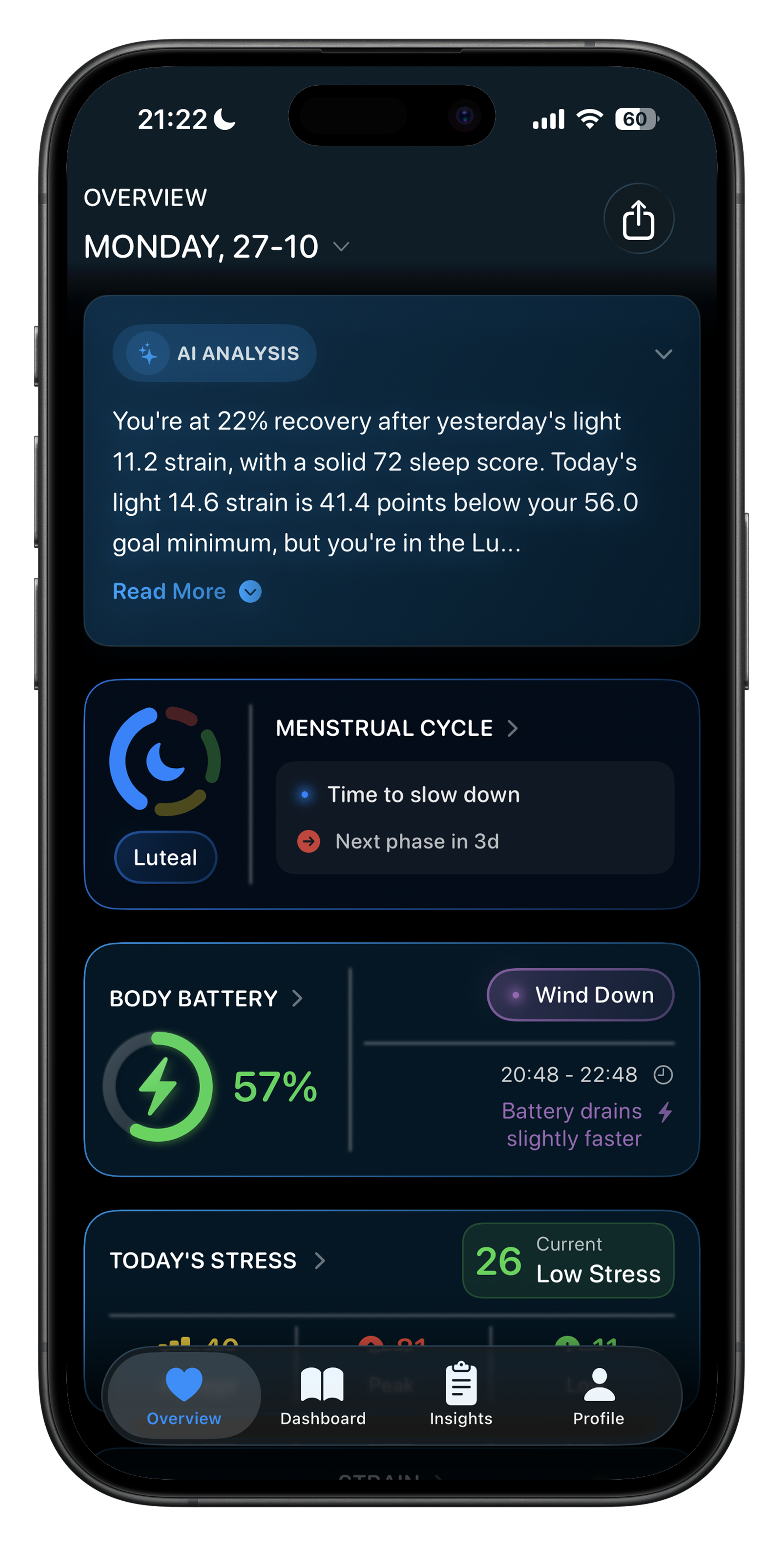
Livity's daily dashboard shows your recovery status, body battery, and HRV trend at a glance.
HRV scores vary enormously between individuals. Age, fitness level, genetics, and time of day all play a role. According to TrainingPeaks, healthy adults typically score 60–70 on common HRV scales, while elite endurance athletes can reach 90–100 or higher.
The most important number is your own baseline. Compare today's HRV to your 7-day or 30-day average — that's what tells you whether your body is recovered or stressed.
General guidelines:
- Above your baseline — recovered, ready for hard training
- Near your baseline — normal, moderate intensity is fine
- Significantly below baseline — nervous system is stressed; consider rest or easy day
HRV also naturally decreases with age, which is why absolute numbers matter far less than your personal trends.
How to Improve Your HRV
The good news: HRV responds to lifestyle changes, sometimes within days.
Sleep — Consistent, high-quality sleep is the single biggest HRV driver. Going to bed at the same time each night can raise HRV within a week.
Exercise — Regular aerobic training improves HRV over time, with clear links to higher VO2 max. But overtraining has the opposite effect — track your HRV to find the right balance.
Stress management — Meditation, breathwork, and slow-paced breathing (5 seconds in, 5 seconds out) activate the parasympathetic system and can raise HRV measurably within a single session.
Alcohol — One of the fastest HRV killers. Even a couple of drinks can visibly drop your morning HRV the next day.
Hydration — Dehydration increases sympathetic nervous system activity, pushing HRV down.
Tracking HRV with Your Apple Watch
Apple Watch measures HRV automatically during sleep using its optical heart rate sensor. It records the SDNN metric — the standard deviation of beat-to-beat intervals — and stores it in Apple Health, giving you a nightly rolling picture of your nervous system health.
Apps like Livity take that raw data and turn it into something actionable — showing your HRV alongside your recovery score, body battery, and stress levels in one clean daily dashboard. No Oura ring or Whoop strap required.
Frequently Asked Questions
What does a low HRV mean? A low HRV typically signals that your body is under stress — from hard training, poor sleep, illness, or psychological strain. It's your nervous system asking for more recovery time.
Is a higher HRV always better? Generally yes, but context matters. Track trends over time rather than reacting to single readings. A slightly lower reading after a hard training block is normal.
How does Apple Watch measure HRV? Apple Watch uses its optical sensor to detect beat-to-beat intervals and calculates SDNN during sleep and background readings throughout the day. The data syncs to Apple Health automatically.
Does HRV decline with age? Yes. HRV naturally decreases as you get older due to changes in autonomic nervous system function. What matters most is your personal trend, not comparing yourself to others.
Can I improve my HRV quickly? Yes — sleep, hydration, and stress reduction can show improvements within days. Consistent aerobic training builds it up over weeks and months.
Start Listening to Your Nervous System
HRV is one of the most honest signals your body sends. It doesn't care about excuses — it just reflects how recovered and balanced your nervous system actually is. Track it daily and you'll start to see clear patterns: when training is paying off, when you need a rest day, when stress is building before you consciously notice it.
Track your HRV with Livity — free to try on the App Store.

iOS developer with 7+ years of experience and an active volleyball player. Built Livity after spending months looking for advanced recovery and sleep tracking that worked natively with Apple Watch — and finding nothing. Uses his own HRV, sleep, and training-load data every day to shape what Livity measures.
More from this authorStart Your Wellness Journey Today
Live Your Best Life
Join thousands of users who are already tracking their health with Livity.