
What Is Sleep Debt? How to Calculate and Recover From It


You skip an hour here, stay up late there, and tell yourself you'll catch up on the weekend. That running tab has a name: sleep debt — the gap between the sleep your body needs and the sleep it actually gets. And it's nearly universal. Roughly one in three U.S. adults sleeps less than seven hours a night, according to CDC data. The problem was never one rough night. It's what happens when the deficit quietly stacks up.
What Is Sleep Debt, Exactly?
Sleep debt (also called a sleep deficit) is the cumulative difference between how much sleep you need and how much you actually get. If your body needs 8 hours and you get 6, you've added 2 hours to the tab. Do that five nights in a row and you're carrying 10 hours of sleep debt into the weekend.
The "cumulative" part is what makes it dangerous. A landmark study published in SLEEP restricted healthy adults to 4, 6, or 8 hours in bed for two weeks. The people sleeping 6 hours a night ended up as impaired on attention and reaction-time tests as people who'd pulled a full all-nighter — and most of them didn't feel that wrecked. Their sense of sleepiness leveled off while their actual performance kept sliding. In other words, sleep debt is a bill that grows even when you've stopped noticing it.
That gap between how you feel and how you're actually functioning is exactly why a number on a screen beats a gut feeling. You can't trust "I feel fine" once the debt is deep.
How to Calculate Your Sleep Debt
The math is simple. Pick your nightly sleep need, multiply by the number of nights, and subtract what you actually slept:
Sleep debt = (your nightly need × nights) − (total sleep you got)
Say your need is 8 hours and here's your week:
| Night | Slept | Deficit |
|---|---|---|
| Monday | 6h 30m | −1h 30m |
| Tuesday | 7h 00m | −1h 00m |
| Wednesday | 6h 00m | −2h 00m |
| Thursday | 6h 45m | −1h 15m |
| Friday | 7h 15m | −0h 45m |
That's 6.5 hours of sleep debt built in a single working week — before the weekend even starts. Most sleep scientists track it on a rolling 14-day window, because that's roughly the horizon over which recent deficits keep affecting you.
Two things make this hard to do in your head. First, you need an honest figure for your nightly need — for most adults that's 7 to 9 hours, but it's personal. Second, you need accurate sleep duration, not "time I was in bed." Lying awake scrolling doesn't count, and people routinely overestimate how long they actually slept.
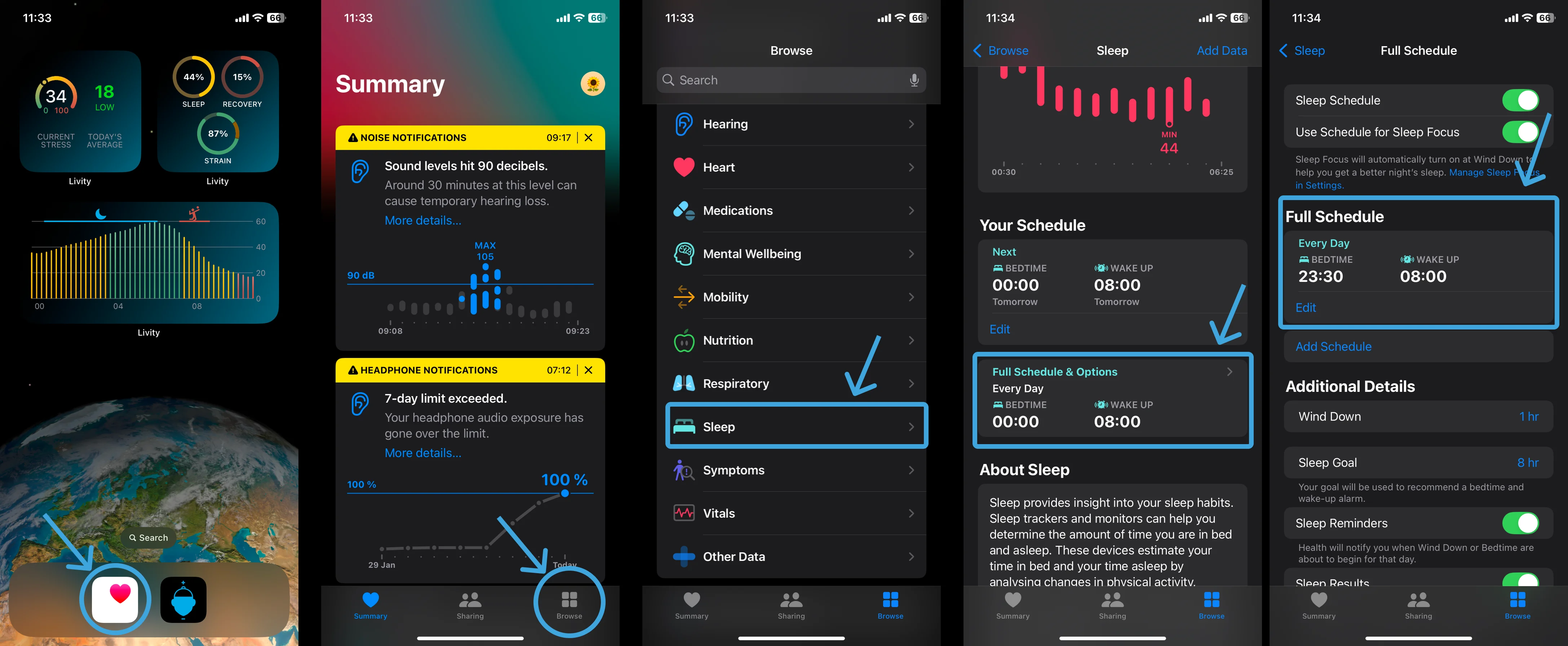 Livity logs how long you actually slept each night straight from your Apple Watch — the raw input you need to see a deficit building.
This is where automatic tracking earns its keep: it measures real sleep night after night so the running total isn't a guess.
📱 Livity tracks your real sleep duration every night from your Apple Watch — so you can watch your sleep debt build and shrink instead of guessing. Try it free →
Why You Can't Just Catch Up on the Weekend
This is the part everyone gets wrong. Sleeping in on Saturday feels like settling the account. The data says otherwise.

In a tightly controlled study in Current Biology, researchers compared three groups: people who slept enough, people who were chronically short on sleep, and people who were short during the week but allowed unlimited "catch-up" sleep on weekends. The weekend-recovery group still gained weight, ate more late at night, and saw their insulin sensitivity drop — in some measures they did worse than the consistently sleep-deprived group, because the Monday crash after a weekend lie-in shoved their body clock even later. The NIH summary put it bluntly: weekend catch-up sleep didn't reverse the metabolic damage.
There's a second reason consistency wins. A 2024 study in SLEEP tracking nearly 61,000 people found that sleep regularity predicted mortality risk more strongly than sleep duration itself — the most regular sleepers had a 20–48% lower risk of death from any cause. Bouncing between five-hour weeknights and ten-hour weekends is the opposite of regular. That swing is what sleep researchers call social jetlag, and it knocks your circadian rhythm around much like flying across time zones every Friday and Sunday.
So weekend recovery isn't useless — extra sleep beats no sleep — but it's a partial payment with a penalty, not a clean reset.
How Long Does It Take to Recover From Sleep Debt?
Longer than a weekend, and longer than most people expect.
When researchers gave chronically sleep-restricted volunteers a single full recovery night, their alertness and mood improved but did not return to baseline — one night wasn't enough to undo the accumulated cost (SLEEP). Follow-up work on multi-week sleep restriction has found that even repeated weekend recovery opportunities fail to fully restore daytime functioning. Recovery is real, but it happens over several consecutive nights of adequate sleep, not in one heroic Sunday.
The practical takeaway: you can't sprint your way out of a deep deficit. You pay it down gradually, the same way it accumulated.
How to Pay Down Sleep Debt the Right Way
You don't need a perfect 9-hour night. You need consistency and a handful of small, repeatable moves:
- Fix your wake time first. A steady wake time anchors your circadian rhythm — and since regularity beats duration for long-term health, this is the single highest-leverage habit. Same alarm, weekends included.
- Add sleep at the front, not the back. Go to bed 20–30 minutes earlier rather than sleeping in. Earlier bedtimes preserve your wake time and keep your clock stable.
- Chip away nightly. An extra 30–60 minutes a night for a week or two clears a moderate debt without the weekend-crash whiplash.
- Nap early and short. A 10–20 minute nap before mid-afternoon can blunt daytime sleepiness without stealing from tonight's sleep.
- Protect the wind-down. Dim light, no doom-scrolling, cooler room. The goal is to fall asleep within ~15–20 minutes so time in bed actually becomes sleep.
- Watch the trend, not one night. Sleep debt is a 14-day story. One bad night is noise; a two-week slide is a signal.
If you want to see whether your debt is actually shrinking, track it. Pairing sleep duration with your next-day recovery and HRV shows the payoff in real numbers — your recovery score tends to climb as the deficit shrinks, which is far more motivating than willpower alone.
What Sleep Debt Does to Your Body
Beyond feeling groggy, a standing sleep debt shows up across your biometrics. Short sleep is linked by the CDC to higher risk of obesity, type 2 diabetes, high blood pressure, and heart disease. Day to day, you'll often see it as a suppressed HRV, an elevated resting heart rate, a flat body battery, and a low next-morning recovery score. Sleep debt also nudges appetite hormones toward "eat more," which is part of why the weekend-recovery group in the metabolic study kept gaining weight. It even bleeds into stress: less sleep means a more reactive nervous system the next day.
These are the exact signals a wearable is built to surface — which is why your tracker often "knows" you're in the red before your motivation does.
Sleep Debt FAQ
Can you ever fully recover from sleep debt? A recent, shallow deficit — yes, over several consistent nights of adequate sleep. But chronic, long-standing sleep restriction is harder to fully reverse, and a single weekend won't do it. The research consistently shows recovery takes multiple nights, and some deficits in daytime functioning linger even after recovery sleep.
How many hours of sleep debt is too much? There's no official threshold, but the SLEEP dose-response study found measurable impairment building from roughly the first week of losing even 1–2 hours a night. As a rule of thumb, a rolling 14-day debt creeping past ~5 hours is worth actively paying down.
Do naps reduce sleep debt? A short early-afternoon nap (10–20 minutes) can ease daytime sleepiness and make a small dent, but it's a supplement, not a substitute for consistent nighttime sleep. Long or late naps can backfire by making it harder to fall asleep that night.
Does sleeping in on weekends help at all? A little — extra sleep is better than none. But studies on weekend catch-up sleep show it doesn't reverse the metabolic toll of weekday loss, and the big weekend-to-weekday swing disrupts your body clock. Consistency beats catch-up.
How does a sleep tracker measure sleep debt? It measures your actual sleep duration each night (not just time in bed) and subtracts it from your sleep need across a rolling window. Because it captures real sleep automatically, the running total is far more accurate than memory — and Livity does this straight from your Apple Watch.
Conclusion
Sleep debt isn't a moral failing or a one-night problem — it's a quiet running total. The good news is it behaves predictably: it builds when you consistently undersleep, and it clears when you give yourself several consistent nights of enough sleep, anchored to a steady wake time. What it won't do is vanish after a single weekend lie-in, no matter how good that Saturday morning feels.
The fix starts with seeing it. Once you can watch the number rise and fall, the habit changes almost take care of themselves.
Start Tracking Your Sleep Debt Today
You can't pay down a debt you can't see. Knowing your real sleep duration — night after night, against your personal need — turns a vague "I'm tired" into a number you can actually move.
Livity tracks your sleep duration, recovery, and HRV automatically from your Apple Watch — no Oura Ring, no Whoop strap, no extra hardware. Free to try on the App Store.
Sources
- Prevalence and Geographic Patterns of Self-Reported Short Sleep Duration Among US Adults, 2020 — CDC — Preventing Chronic Disease, 2023
- The Cumulative Cost of Additional Wakefulness: Dose-Response Effects on Neurobehavioral Functions and Sleep Physiology From Chronic Sleep Restriction and Total Sleep Deprivation — SLEEP, 2003
- Ad libitum Weekend Recovery Sleep Fails to Prevent Metabolic Dysregulation during a Repeating Pattern of Insufficient Sleep and Weekend Recovery Sleep — Current Biology, 2019
- Sleep regularity is a stronger predictor of mortality risk than sleep duration: A prospective cohort study — SLEEP, 2024

iOS developer with 7+ years of experience and an active volleyball player. Built Livity after spending months looking for advanced recovery and sleep tracking that worked natively with Apple Watch — and finding nothing. Uses his own HRV, sleep, and training-load data every day to shape what Livity measures.
More from this authorStart Your Wellness Journey Today
Live Your Best Life
Join thousands of users who are already tracking their health with Livity.