
Baby Sleep vs Adult Sleep: Why Sleep Changes as We Grow

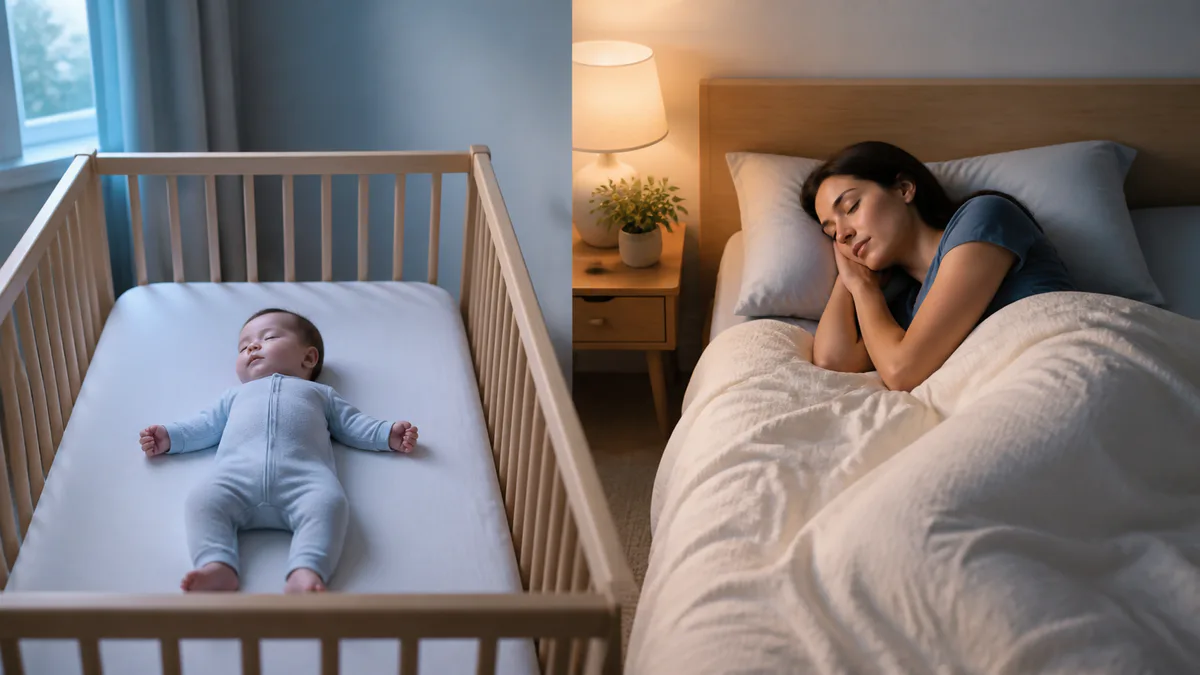
The biggest difference in baby sleep vs adult sleep is not simply that babies need more hours. Baby sleep is spread across the day and night, organized into shorter and less mature patterns, and recorded by someone else. Adult sleep is usually concentrated into one nighttime period and shaped by a mature circadian clock.
Those differences gradually narrow as a child grows. Sleep becomes more consolidated, its internal stages become more adult-like, and daytime naps recede. For the detailed hour-by-hour recommendations, see our sleep needs by age guide. Here, the more interesting question is why the pattern changes.
Baby Sleep vs Adult Sleep Starts With More Than Hours
The duration contrast is real. The American Academy of Sleep Medicine recommends 12–16 hours per 24 hours, including naps, for infants aged 4–12 months, while its adult consensus recommends that healthy adults regularly get at least seven hours per night (pediatric consensus; adult consensus).
The AASM pediatric recommendation starts at 4 months, so it does not provide a range for newborns. The National Sleep Foundation's lifespan guidance provides broader age ranges, but it also emphasizes that recommended hours are population-level ranges rather than an exact target for every individual (National Sleep Foundation recommendations).
The more useful distinction is this:
- A baby's total is accumulated across naps and nighttime sleep.
- An adult's total usually comes from one main nighttime period.
- A baby's longest sleep period may still contain several observable wakes.
- An adult can briefly wake between cycles without remembering it in the morning.
Two people can therefore log the same three-hour stretch and have very different sleep stories. For an adult, it may be an unusually short night. For a young baby, it may be one part of a full 24-hour pattern.
Why Baby Sleep Is Spread Across Day and Night
Adults have a mature circadian system that helps coordinate alertness during the day and sleep at night. Newborns do not arrive with that day–night pattern fully established. Sleep and waking are initially distributed across the 24-hour day, then gradually become more organized as circadian and homeostatic regulation develop.
A major review of early childhood sleep found that sleep is the predominant state at birth and that its organization changes substantially during the first two years alongside development (Lenehan et al., 2023). This is a process, not a switch that flips on one particular birthday.
That helps explain why judging infant sleep only by the nighttime stretch can be misleading. Daytime naps are not optional extras added on top of “real” sleep; they are part of the infant's total sleep pattern. As more sleep consolidates at night, the balance changes and the number of daytime sleep periods generally falls.
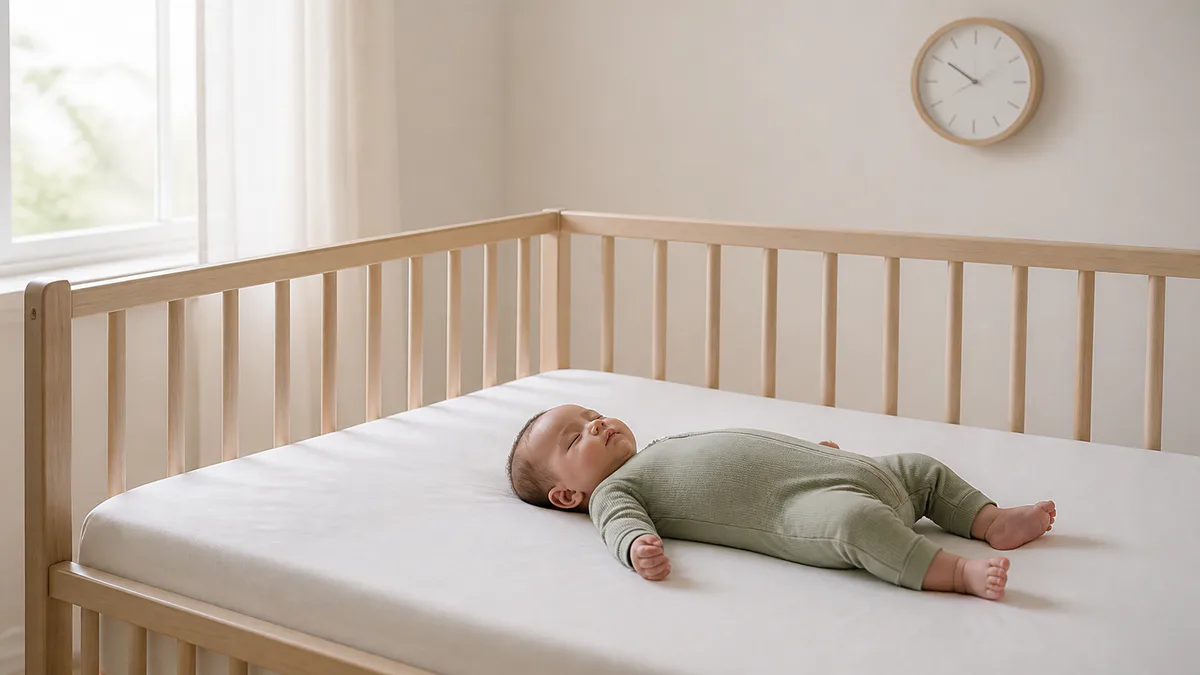
An adult tracker can often summarize a single overnight session. Understanding a baby's pattern usually requires looking at the whole day: when sleep began, how long it lasted, when the baby woke, and how those events were distributed across several days.
Baby and Adult Sleep Architecture Are Built Differently
Sleep architecture describes the internal organization of sleep: the states or stages that appear, their order, and how they alternate through a sleep period.
In adults, sleep is divided into non-rapid eye movement sleep—N1, N2, and N3—and rapid eye movement sleep, or REM. These stages repeat through the night. Deep N3 sleep is concentrated more heavily earlier in the night, while REM periods tend to become longer later in the sleep period (NHLBI overview of sleep stages).
Newborn sleep is commonly described using active sleep and quiet sleep, rather than treating it as a miniature version of the adult staging system. These early states develop into more recognizable NREM and REM organization as the nervous system matures.
The review of the first two years found an overall increase in NREM sleep and decrease in REM sleep across that period (Lenehan et al., 2023). That does not mean REM becomes unimportant. It means the proportion and organization of the stages are changing as the child develops.
Infant sleep cycles are also shorter and organized differently from adult cycles. The practical result is more frequent transitions between sleep states. A partial arousal at one of those transitions may be visible to a caregiver even when the baby returns to sleep quickly (Lenehan et al., 2023).
This is why adult expectations do not map cleanly onto infant sleep. “Woke between cycles” can describe part of normal sleep organization; it does not, by itself, identify a sleep disorder or a parenting problem.
📱 Livity shows adult sleep duration, stages, and recovery trends from your Apple Watch, helping you compare patterns across nights instead of judging one isolated score. Try it free →
Adult Sleep Is Consolidated, Not Motionless
A mature circadian rhythm makes it easier to sustain one main nighttime sleep period, but adult sleep is not eight hours of one unchanging state. The brain continues moving through NREM and REM sleep, and brief arousals can occur between cycles.
The important difference is consolidation. Most healthy adults can keep the bulk of their sleep inside one nightly window. The AASM recommendation of at least seven hours is a baseline for healthy adults, not proof that everyone performs equally well on the same number (Watson et al., 2015).
That is also why a single “eight hours” result can be incomplete. Duration matters, but so do continuity, timing, and the next-day response. A full night that is repeatedly interrupted may feel very different from an equally long, well-consolidated night.
What Changes Again in Later Adulthood
Children do not simply become adult sleepers and stay that way forever. Sleep architecture continues to change through adulthood, although the shift is more subtle than the rapid development seen in infancy.
A meta-analysis of 65 studies involving 3,577 healthy participants aged 5–102 found several age-related trends in adults. Total sleep time, sleep efficiency, slow-wave sleep, REM percentage, and REM latency decreased with age, while sleep latency, lighter sleep, and wake time after sleep onset increased (Ohayon et al., 2004).
The findings need careful interpretation. The researchers noted that screening for medical conditions, sleep disorders, medication, alcohol use, and mental health substantially affected the apparent age associations. After age 60, only the decline in sleep efficiency remained statistically significant across the included data.
In plain language: older sleep often becomes lighter or more fragmented, but that does not mean older adults suddenly need very little sleep. The National Sleep Foundation's range changes only modestly, from seven to nine hours for most adults to seven to eight for adults 65 and older (Hirshkowitz et al., 2015).
Poor sleep should not automatically be dismissed as “just aging.” Persistent insomnia, excessive daytime sleepiness, loud snoring, or waking with gasping deserves a conversation with a qualified healthcare professional.
Tracking Baby Sleep vs Adult Sleep
The biology differs, and so does the measurement.
For babies, a caregiver has to record what happened, so a paper diary or a baby tracker can keep naps and nighttime wakes in one timeline.
For adults, a watch can collect movement and physiological signals automatically while the wearer sleeps. Apps can then organize those signals into estimates of duration, timing, stages, and recovery-related trends.
| Question | Baby sleep tracking | Adult sleep tracking |
|---|---|---|
| Who records it? | A parent or caregiver | Usually a wearable automatically |
| Main time window | The full 24-hour day | Primarily overnight |
| Most useful events | Nap starts and ends, nighttime wakes | Sleep timing, duration, continuity, stages |
| Best interpretation | Developmental patterns across days | Personal trends across nights |
| What it cannot do | Diagnose a medical or developmental issue | Replace a clinical sleep study |
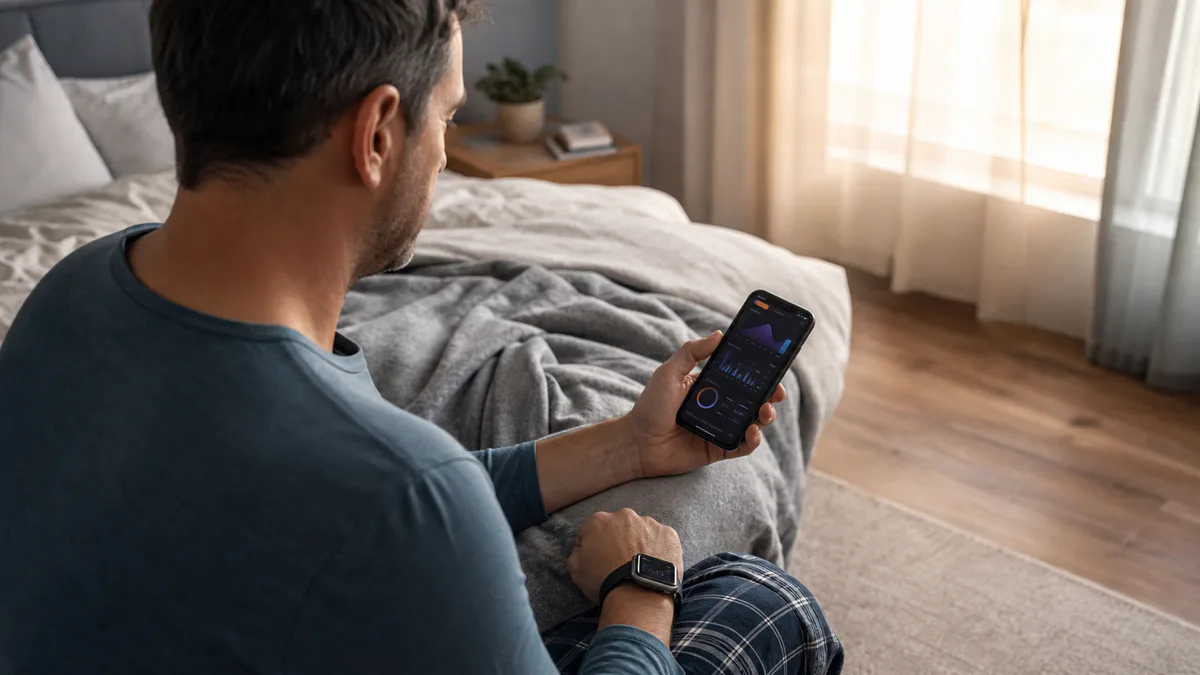
The two records answer different questions. An infant log helps reconstruct a day that the baby cannot report. An adult wearable helps the same person compare sleep with how they felt and recovered afterward.
In my own Livity overview, I have seen that a longer night does not always produce the same recovery result. That does not make duration irrelevant. It is a reminder to look at several nights together and include context instead of treating one number as a verdict.
Neither type of tracking is a diagnosis. Concerns about an infant's breathing, feeding, development, or safe sleep setup belong with a pediatric professional. Persistent adult sleep symptoms belong with a clinician rather than an app score.
Frequently Asked Questions About Baby Sleep vs Adult Sleep
Why do babies wake more often than adults?
Infant sleep is distributed across more sleep periods, its circadian organization is still developing, and transitions between shorter sleep states occur more frequently. Early sleep architecture changes rapidly during the first two years, so waking patterns can also change with development (Lenehan et al., 2023).
When does baby sleep become like adult sleep?
There is no single age when the change is complete. Sleep becomes progressively more consolidated and its architecture more adult-like across infancy and childhood. The first two years contain particularly rapid changes in the balance of NREM and REM sleep (Lenehan et al., 2023).
Do babies have REM and deep sleep?
Babies have distinct sleep states, but newborn sleep is not staged exactly like adult sleep. Active and quiet sleep gradually develop into more recognizable REM and NREM organization. Reviews show REM decreasing proportionally while NREM increases across the first two years (Lenehan et al., 2023).
Do older adults need less sleep than younger adults?
Only slightly less according to the National Sleep Foundation's ranges: seven to nine hours for most adults and seven to eight for adults 65 and older (Hirshkowitz et al., 2015). The more noticeable age-related change is often lighter, less efficient, or more fragmented sleep (Ohayon et al., 2004).
Can a sleep tracker diagnose a problem?
No. A caregiver log or wearable can reveal useful patterns, but neither replaces medical evaluation. Use the record to describe what has been happening clearly, especially when symptoms persist or affect daytime functioning.
What Baby Sleep vs Adult Sleep Really Shows
Sleep does not simply shrink from “many hours” to “fewer hours” as we grow. It reorganizes. Naps and short sleep periods gradually give way to a consolidated night, early sleep states mature into adult architecture, and later adulthood brings another shift toward lighter and less efficient sleep.
The useful comparison is not whether a baby or adult slept “better.” Their sleep systems are doing different things at different stages of life. Track each one in a way that fits the question, and judge patterns over time rather than one isolated night.
Start Tracking Adult Sleep Patterns Today
For adults, the most useful sleep record connects duration and timing with recovery across several nights. That makes it easier to spot a real pattern without overreacting to one unusual score.
Livity tracks your adult sleep, recovery, and related health trends automatically from your Apple Watch—no Oura Ring, no Whoop strap, no extra hardware. Free to try on the App Store.
Sources
- Recommended Amount of Sleep for Pediatric Populations: A Consensus Statement of the American Academy of Sleep Medicine — Journal of Clinical Sleep Medicine, 2016
- Recommended Amount of Sleep for a Healthy Adult: A Joint Consensus Statement of the American Academy of Sleep Medicine and Sleep Research Society — Journal of Clinical Sleep Medicine, 2015
- National Sleep Foundation's Sleep Time Duration Recommendations: Methodology and Results Summary — Sleep Health, 2015
- The Architecture of Early Childhood Sleep Over the First Two Years — Maternal and Child Health Journal, 2023
- Meta-analysis of Quantitative Sleep Parameters From Childhood to Old Age in Healthy Individuals: Developing Normative Sleep Values Across the Human Lifespan — Sleep, 2004

iOS developer with 7+ years of experience and an active volleyball player. Built Livity after spending months looking for advanced recovery and sleep tracking that worked natively with Apple Watch — and finding nothing. Uses his own HRV, sleep, and training-load data every day to shape what Livity measures.
More from this authorStart Your Wellness Journey Today
Live Your Best Life
Join thousands of users who are already tracking their health with Livity.