
Heart rate variability (HRV) explained: what it is, why it matters, and how to improve it
Your heart doesn't beat like a clock. Even at 60 beats per minute, the gap between individual beats varies — sometimes 0.9 seconds, sometimes 1.1 seconds. That variation is heart rate variability (HRV), and it's one of the most useful numbers your body produces.
HRV has moved from cardiology labs to consumer wearables in the last decade. Apple Watch tracks it. Whoop and Oura are built around it. But most people still don't really know what they're looking at. This article fixes that.
What is HRV, actually?
HRV measures the variation in time between consecutive heartbeats — specifically the gaps between the R-peaks on an electrocardiogram, called RR intervals. It's calculated in milliseconds.
The most common method is RMSSD (root mean square of successive differences), which is what Apple Watch and most consumer wearables use. It's sensitive to short-term changes in the parasympathetic nervous system, which makes it ideal for tracking day-to-day recovery.
Crucially, HRV isn't controlled by your heart directly. It originates in your autonomic nervous system (ANS) — the part of your nervous system that runs quietly in the background, handling heart rate, blood pressure, digestion, and breathing without you having to think about it.
The autonomic nervous system: why it matters for HRV
The ANS has two branches working in opposition:
- Sympathetic nervous system ("fight or flight") — activates under stress, exercise, or threat. Speeds up your heart rate and narrows beat-to-beat variation.
- Parasympathetic nervous system ("rest and digest") — activates during recovery and calm states. Slows your heart rate and increases beat-to-beat variation.
When both branches are active and balanced, they're constantly nudging your heart in opposite directions — faster, slower, faster, slower. That tug-of-war produces high variability.
When one branch dominates — usually the sympathetic during stress or fatigue — variability drops. Your heart rate becomes more rigid, more mechanical. Low HRV.
So HRV is really a window into your nervous system balance. A high reading says your body is adaptable and ready. A low reading says it's under load — whether from hard training, poor sleep, alcohol, illness, or emotional stress.
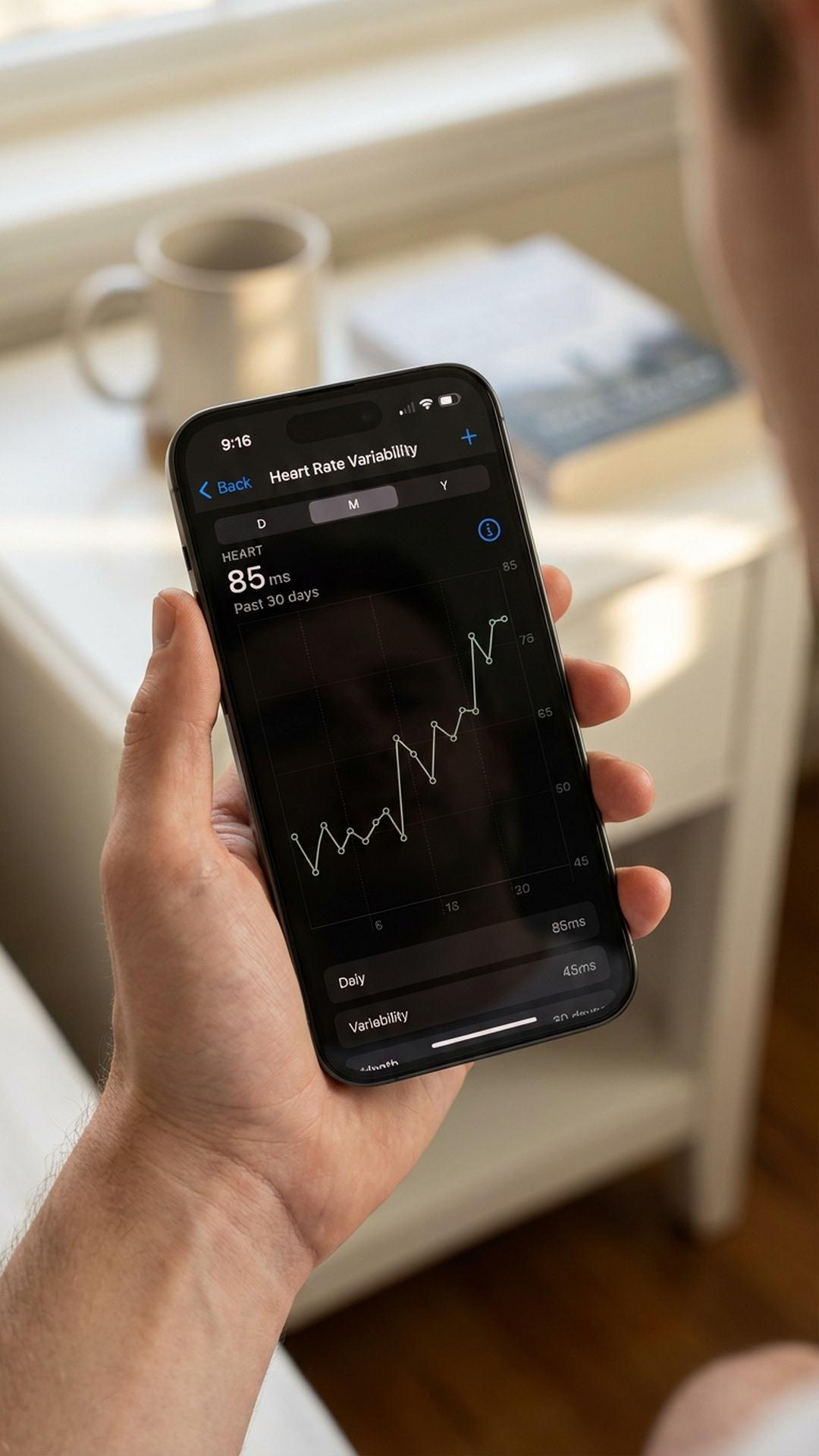 Generated illustration — Apple Health HRV chart showing daily readings over 30 days. A rising trend means improving recovery.
What is a good HRV number?
The honest answer: it depends entirely on you. HRV varies enormously between individuals — much more than metrics like resting heart rate. Two people who are equally fit can have baseline HRVs of 40ms and 90ms and both be perfectly healthy.
The variables that determine your baseline:
| Factor | Effect |
|---|---|
| Age | HRV decreases with age — significantly |
| Sex | Males typically have slightly higher HRV |
| Fitness level | Higher fitness → higher HRV |
| Genetics | Partially hardwired — some people are just higher |
Rough age-based averages (WHOOP data):
- Ages 20–25: middle 50% range is roughly 55–105ms
- Ages 40–45: middle 50% range is roughly 35–65ms
- Ages 60–65: middle 50% range is roughly 25–45ms
Elite endurance athletes often score considerably higher than these ranges.
The key insight: don't compare your HRV to anyone else's. Track your own baseline over weeks and watch the trend. A gradual upward trend over months means your fitness and recovery are improving. A sudden drop from your personal baseline is the signal worth paying attention to.
What low HRV is actually telling you
A dip below your personal baseline is your nervous system raising a flag. It doesn't mean something is wrong — it means your body is currently under load. Common causes:
- Hard training without adequate recovery — especially consecutive intense sessions
- Poor sleep — even one bad night measurably suppresses HRV
- Alcohol — one night of drinking can suppress HRV for up to 5 days
- Illness — HRV often drops before you even feel sick
- Emotional stress — your ANS doesn't distinguish between physical and psychological load
- Dehydration — reduces blood volume, increases cardiovascular strain
- Jet lag / disrupted circadian rhythm
A chronically low HRV — consistently well below your baseline for weeks — may be worth discussing with a doctor. It has been associated with cardiovascular disease risk and burnout in research settings.
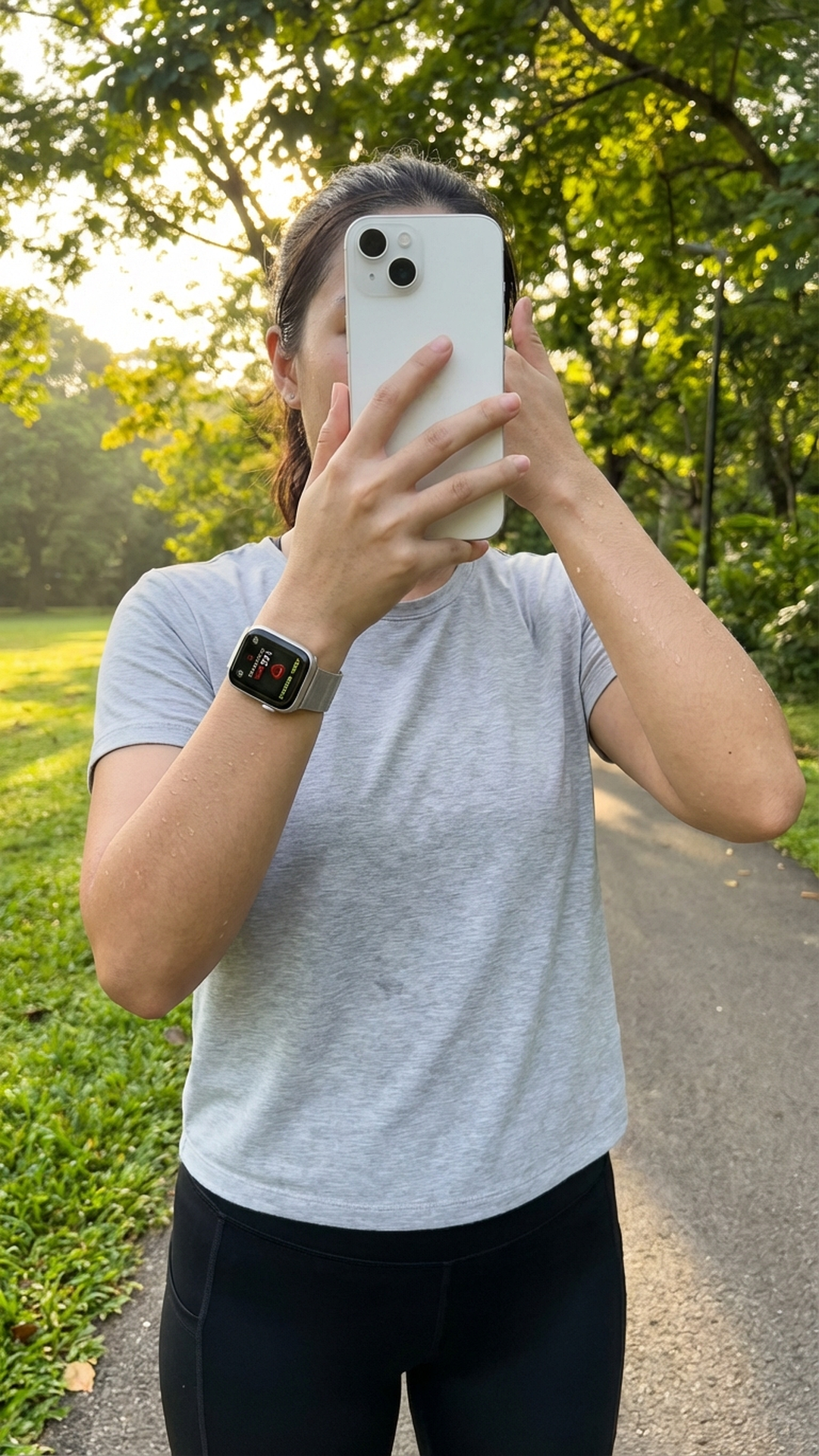 Generated illustration — HRV is best checked in the morning before training, not immediately after exercise.
How to improve your HRV
You can't hack HRV directly. But you can create conditions where your ANS stays balanced and your parasympathetic system gets more airtime.
1. Prioritise sleep consistency over total hours Going to bed and waking at the same time every day — including weekends — stabilises your circadian rhythm, which directly regulates ANS tone. Irregular sleep patterns tank HRV even when total duration is adequate.
2. Train smart, not just hard HRV is the canary for overtraining. After hard sessions, your HRV will dip — that's normal and expected. Problems arise when you push again before it recovers. Use your HRV trend to decide when to push and when to back off.
3. Cut alcohol Alcohol is one of the most potent HRV suppressors. Even moderate drinking — a glass or two of wine — measurably drops HRV the following day. One heavy night can suppress it for 4–5 days. The data is unambiguous.
4. Manage your stress response, not just your stress You can't eliminate stress. But practices that activate the parasympathetic system — slow diaphragmatic breathing, cold exposure, meditation — have consistent evidence for improving HRV over time. Even 5 minutes of slow breathing (4-7 seconds inhale, 6-8 seconds exhale) measurably shifts ANS balance.
5. Stay hydrated Dehydration forces your heart to work harder to circulate blood. Even mild dehydration suppresses HRV. Aim for roughly 30ml per kg of bodyweight daily as a baseline.
6. Cardio over strength training for HRV gains Endurance athletes consistently show higher HRV than strength athletes. Zone 2 aerobic training (conversational pace, sustained for 30–60 minutes) is particularly effective for building parasympathetic capacity over time.
HRV on Apple Watch: how it works and where to find it
Apple Watch measures HRV during sleep using its optical heart rate sensor (photoplethysmography). It calculates RMSSD from the RR intervals detected while you're asleep — specifically during the deepest sleep windows.
Where to find it:
- Open the Health app on iPhone
- Browse → Heart → Heart Rate Variability
- You'll see a daily chart; switch to weekly or monthly to spot trends
Apple Watch measures HRV nightly — you don't need to manually trigger it. The more consistently you wear it to sleep, the better your baseline will be. A few weeks of data is enough to see meaningful trends.
Important: check your HRV in the morning, before caffeine, before exercise. That resting morning measurement is the most comparable day to day. An HRV reading taken mid-workout tells you almost nothing useful about recovery.
Frequently Asked Questions
What is a normal HRV for my age? There's no single normal — ranges vary dramatically. As a rough guide: 20s typically 55–105ms, 40s typically 35–65ms, 60s typically 25–45ms (RMSSD via WHOOP data). More importantly, establish your personal 60-day average and track deviation from that.
Why is my HRV low even when I sleep well? Sleep is one of many factors. Check alcohol intake from recent days, training load over the past week, stress levels, and hydration. HRV reflects total systemic load, not just last night's sleep.
Does Apple Watch HRV match medical-grade measurements? Consumer wearables are less accurate than medical ECG-based HRV, but they're consistent enough to be useful for tracking trends over time. The trend matters more than any single absolute number.
Why does my HRV jump around so much day to day? Because everything affects it. Normal daily variation of ±10–20ms is completely expected. That's why you should track 7-day or 30-day averages rather than reacting to individual readings.
Can I increase my HRV quickly? Short-term: a single good night of sleep, proper hydration, and avoiding alcohol can move it noticeably. Long-term: consistent aerobic training, sleep discipline, and stress management over months will raise your baseline. There are no real shortcuts.
The bottom line
HRV is your nervous system talking. High variability means it's adaptable, balanced, and ready. Low variability means it's carrying load — whether from training, stress, poor sleep, or something else entirely.
The number itself matters less than your trend over time. Get 4–6 weeks of consistent morning readings, establish your baseline, and use deviations as data — not as cause for anxiety.
Livity tracks your HRV nightly from Apple Watch and turns it into a daily recovery score — so you get one clear signal each morning instead of trying to interpret raw milliseconds yourself. No Whoop strap, no Oura Ring. Just your watch. Try Livity free on the App Store.