
Training Readiness & Rest Hours: When to Train and When to Rest
Last updated: May 29, 2026
Training Readiness and Rest Hours, explained
Training Readiness and Rest Hours are two recovery metrics that work together to answer one simple question: should you train hard today, or should you rest? Training Readiness is a single morning score from 0 to 100 that tells you how prepared your body is for a hard session right now. Rest Hours is a recovery countdown — the number of hours until your body is fully recovered from recent training.
Together they turn your HRV, sleep, training load, and the recovery cost of your workouts into a clear daily recommendation — so you can push when your body is ready and back off before fatigue turns into injury or burnout.
- Am I ready to train hard today?
- How many hours until I'm fully recovered?
- Why do the two scores sometimes disagree?
What Training Readiness Measures
Training Readiness blends overnight recovery, sleep, training load, body battery, and vitals into one morning number from 0 to 100. The higher the score, the more prepared your body is to absorb a hard session. Livity recalculates it every morning and refreshes it during the day after workouts or big swings in your body battery.
The six inputs behind your score
Recovery
Your overnight heart rate variability (HRV) and resting heart rate compared to your own baseline — the single biggest driver of the score.
Sleep
How long you slept and how much deep and REM sleep you got, measured against your sleep goal.
Load Balance
Your recent training load versus your longer-term load (the acute:chronic workload ratio), so a sudden spike lowers your readiness.
Body Battery
How much energy you recharged overnight and how much you have in the tank this morning.
Vitals
Wrist temperature, respiratory rate, and blood-oxygen drift versus your baseline — early signals of illness or strain.
Stress
Your average stress level — sustained high stress quietly lowers your readiness to perform.
Training Readiness needs 3–7 nights of overnight Apple Watch data to build your personal baseline before it can score you. Wear your Watch to sleep and your score will appear each morning.
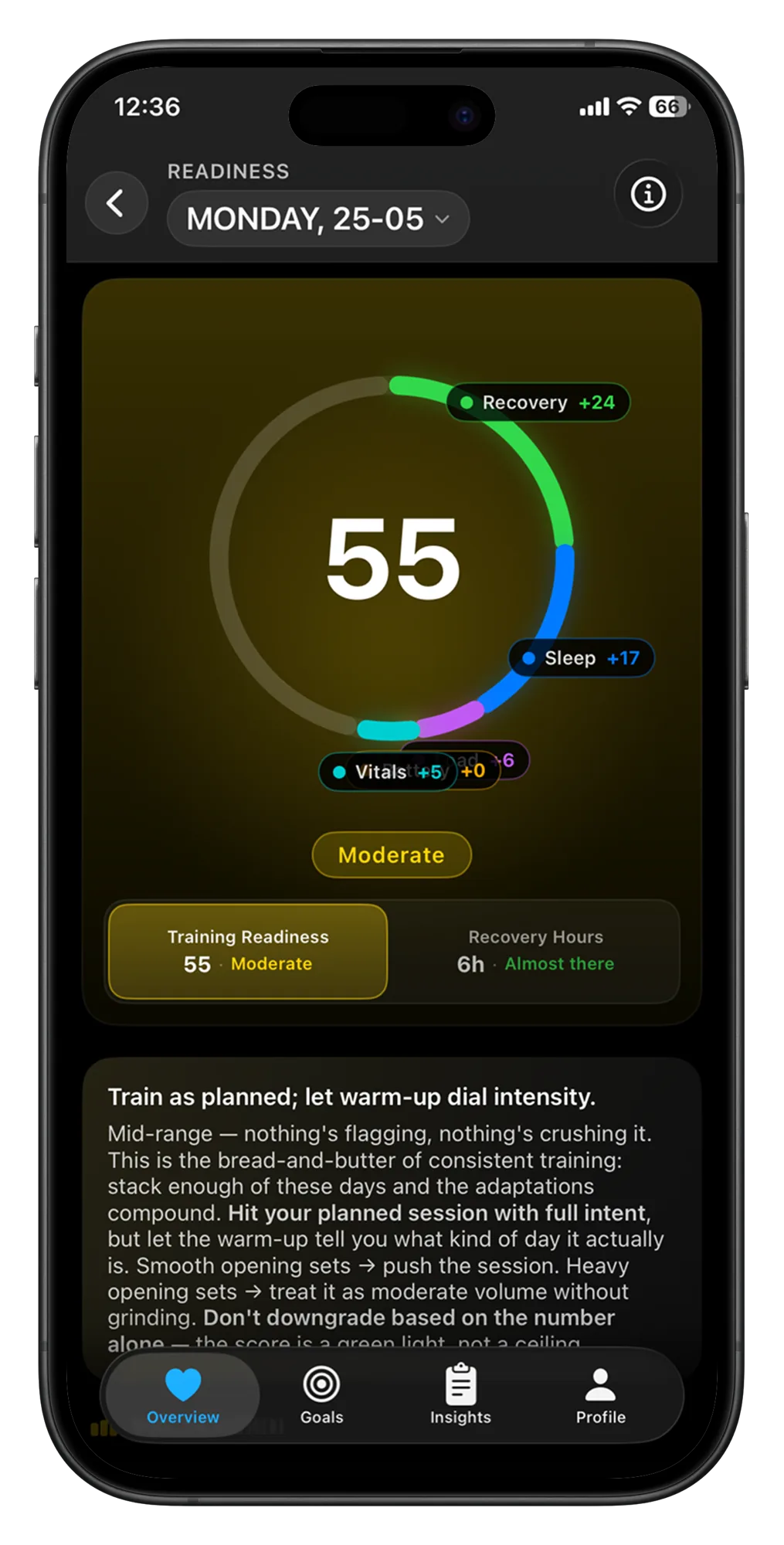
The Five Training Readiness Levels
Your score falls into one of five bands. Use them as a starting point, not a hard rule — how you feel still matters.
Prime (85–100)
Peak readiness. Your body is primed to adapt — this is the time for your hardest or most important session.
Ready (70–84)
Good readiness. You're ready for moderate-to-hard training; train as planned.
Moderate (50–69)
Moderate readiness. Train, but consider dialing back the intensity or volume a little.
Low (30–49)
Low readiness. Keep it easy today — an aerobic session, mobility work, or active recovery.
Rest (0–29)
Very low readiness. Prioritize recovery; a rest day now protects your progress.
What Rest Hours Measures
Rest Hours is the number of hours until you're fully rested — a recovery countdown from 0 to 96 hours. It tracks the fatigue your training creates and ticks down as your body recovers.
How the countdown moves
Workouts add hours
Every workout adds hours based on its true physiological cost, estimated from your heart rate using the EPOC (excess post-exercise oxygen consumption) model — the harder and longer the session, the more hours it adds.
Good sleep subtracts hours
Sleep pays your fatigue down: the better you sleep, the more it clears — a strong night makes a real dent, an average night less, and poor sleep barely moves the needle.
Time helps too
Time helps too — the countdown naturally eases down as the hours pass, whether you're awake or asleep.
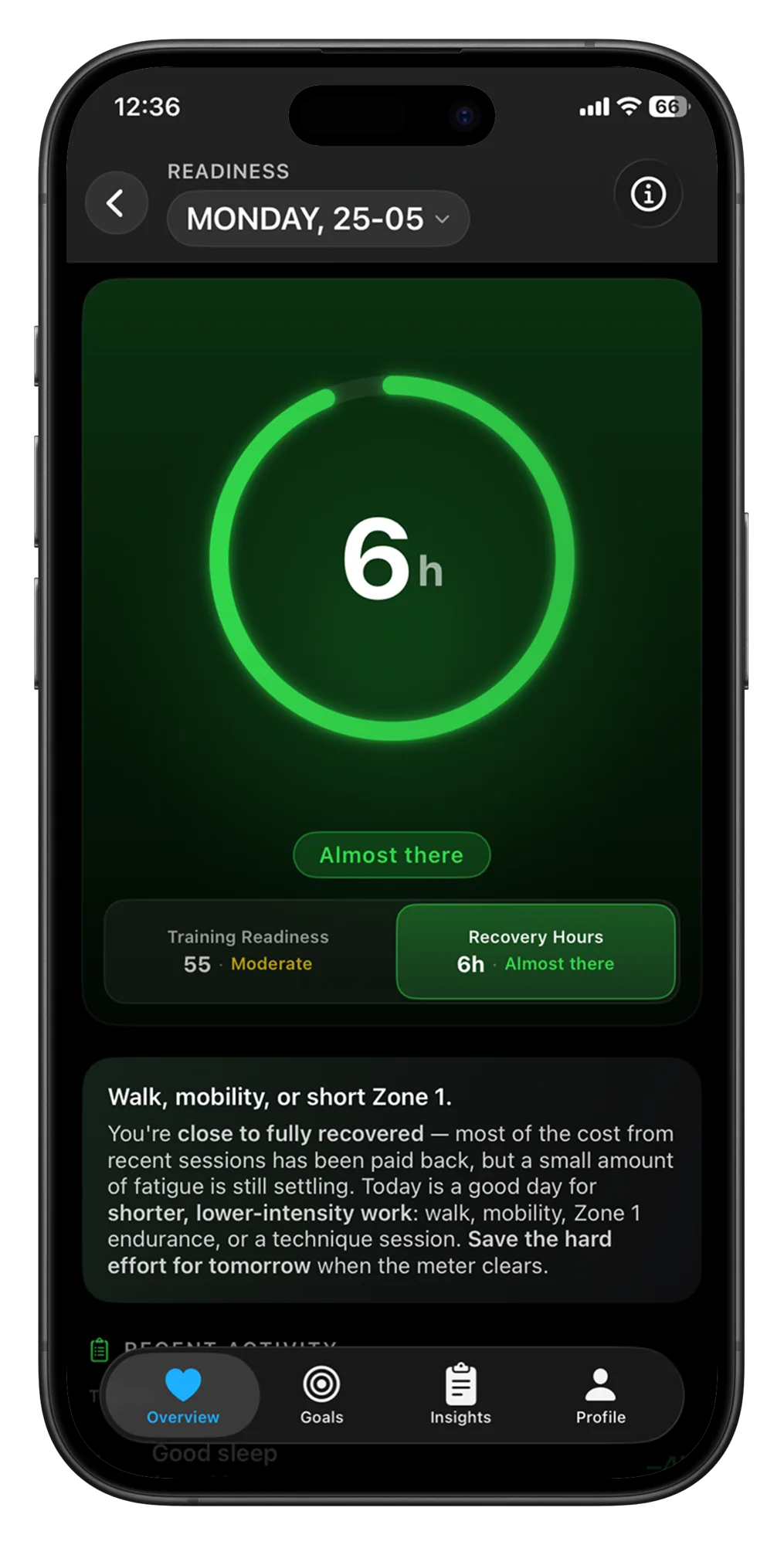
The Six Rest Hours Levels
Rested (under 0.5h)
Fully recovered and ready to train hard.
Almost There (0.5–8h)
Minor fatigue — you can still push if you need to.
Recovering (8–24h)
Moderate fatigue — ease off the intensity.
Take It Easy (24–48h)
Significant fatigue — keep it light today.
Rest Day (48–72h)
Heavy fatigue — make recovery the priority.
Rest First (72–96h)
Maximum fatigue — rest before any hard training.
How the Two Work Together
Training Readiness answers "how prepared am I right now?" while Rest Hours answers "how much fatigue am I still carrying?" They look at recovery from two angles, and Livity shows them side by side on your Overview so you get the full picture at a glance.
They're also linked under the hood: when your Rest Hours are high, it lowers your Training Readiness, because lingering fatigue makes a hard session riskier.
When they disagree
Sometimes Readiness says "Ready" while Rest Hours still says "Rest Day" — for example, when your HRV and sleep have bounced back quickly but a big training block is still being repaid. When that happens, Livity shows a short Training Load note explaining the mismatch so you can make the call with full context.
The Science Behind It
Both metrics are built on established sports-science research, not guesswork. Here's the reasoning behind each input.
HRV and your nervous system
Heart rate variability reflects the balance of your autonomic nervous system. When you're recovered, the parasympathetic "rest and digest" branch dominates and HRV sits at or above your baseline; accumulated fatigue, poor sleep, or illness shift you toward sympathetic "fight or flight" dominance and HRV drops. Tracking HRV against your own baseline is a well-validated way to monitor training adaptation and recovery.
Balancing training load
The acute:chronic workload ratio compares what you've done recently to what you're used to. A systematic review found the lowest injury risk sits in a "sweet spot" of roughly 0.8–1.3 — train far above what your body is prepared for and injury risk climbs. That's why a sudden spike in load pulls your readiness down.
The recovery cost of exercise
After a hard session your body keeps consuming extra oxygen to return to baseline — excess post-exercise oxygen consumption, or EPOC. Its size scales with how intense and how long the workout was, which makes it a reliable way to estimate how many hours of recovery a session actually costs.
Why sleep pays down fatigue
Sleep is when the body repairs and adapts. Research in elite athletes shows that sleep loss impairs recovery and performance, while adequate sleep restores it — which is why a good night meaningfully reduces your Rest Hours.
How to Use These Scores
A simple way to put Training Readiness and Rest Hours to work:
- •Schedule hard sessions for Prime or Ready mornings when your Rest Hours are also low.
- •Go easy when Readiness is Low or Rest, or Rest Hours says Take It Easy or worse.
- •Trust the trend over any single day — one low score is normal; several in a row is a real signal.
- •Listen to your body too — these scores guide your decision, they don't override how you actually feel.
Common Questions
Why is my Training Readiness low after a good night's sleep?
Sleep is only one of several inputs. A low score despite good sleep usually means your HRV or resting heart rate is off baseline, your recent training load spiked, or your vitals suggest you're fighting something off.
Why are my Rest Hours high when Readiness says I'm Ready?
Readiness can rebound quickly once your HRV and sleep recover, while Rest Hours repays the full physical cost of a big training block more slowly. When they diverge, Livity shows a note explaining why.
Do I need an Apple Watch?
Yes. Both metrics rely on overnight heart rate, HRV, and sleep data from your Apple Watch. Wear it to sleep for 3–7 nights so Livity can build your baseline.
How often do the scores update?
Training Readiness is calculated each morning and refreshes during the day after workouts or large body-battery changes. Rest Hours updates continuously as workouts add fatigue and sleep and time pay it down.
Is this medical advice?
No. Training Readiness and Rest Hours are informational fitness tools to help you plan training and recovery. They are not a medical device and shouldn't be used to diagnose or treat any condition.
Research & Sources
These metrics draw on peer-reviewed sports-science research, including:
- Plews et al. (2013). Training Adaptation and Heart Rate Variability in Elite Endurance Athletes. Sports Medicine.
- Maupin et al. (2020). The Relationship Between Acute:Chronic Workload Ratios and Injury Risk in Sports: A Systematic Review. Open Access Journal of Sports Medicine.
- LaForgia, Withers & Gore (2006). Effects of exercise intensity and duration on the excess post-exercise oxygen consumption. Journal of Sports Sciences.
- Halson (2014). Sleep in elite athletes and nutritional interventions to enhance sleep. Sports Medicine.
A note on these scores
Training Readiness and Rest Hours are guides, not guarantees. They're designed to help you make smarter training and recovery decisions — but they don't replace how you feel, a coach's judgment, or medical advice. If something feels wrong, rest and consult a professional.