
What Is a Good HRV by Age? (Chart + Normal Ranges)

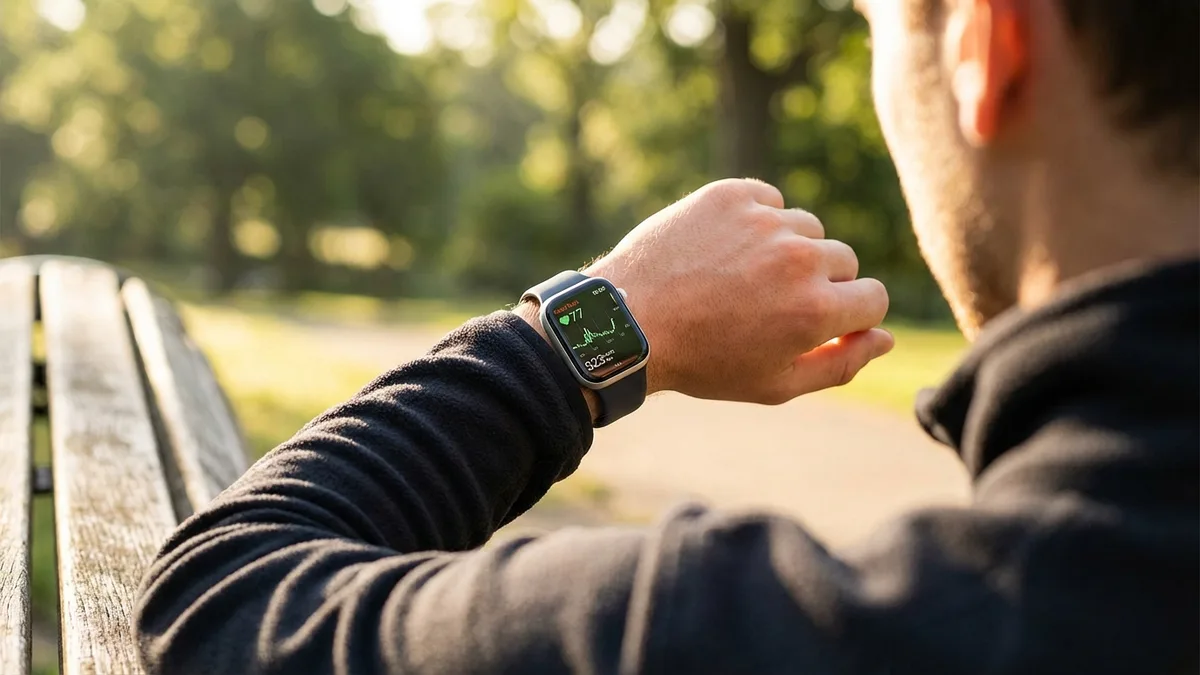
You finally start tracking your heart rate variability and immediately Google "what's a good HRV score." The first thing you find is a chart showing athletes with scores above 100. Yours is 38. Panic sets in.
Take a breath. Your HRV is deeply personal, and comparing it to someone else's number without context is like comparing your shoe size to theirs and worrying about the difference. What matters is understanding where your number falls relative to your age — and then watching your own trend over time.
What Is HRV? (Quick Refresher)
Heart rate variability measures the variation in time between consecutive heartbeats, in milliseconds. Your heart doesn't beat like a metronome — the gaps between beats constantly fluctuate, driven by your autonomic nervous system.
Higher HRV generally means your nervous system is flexible and recovered. Lower HRV signals stress, fatigue, or incomplete recovery. If you want the full breakdown, check out our HRV explained guide.
The metric you'll see most often on wearables is RMSSD (Root Mean Square of Successive Differences) — it's the standard way to measure beat-to-beat variation and reflects parasympathetic (rest-and-recover) nervous system activity.
Average HRV by Age: The Numbers
Here's what population data from multiple studies tells us about typical RMSSD values by age group. These ranges represent the middle 50% of healthy adults — meaning 25% of people score above and 25% below these ranges.
| Age Group | Average RMSSD (ms) | Typical Range (ms) |
|---|---|---|
| 18–25 | 60–80 | 45–105 |
| 26–35 | 50–70 | 40–90 |
| 36–45 | 40–55 | 30–75 |
| 46–55 | 30–45 | 22–60 |
| 56–65 | 25–38 | 18–50 |
| 65+ | 20–30 | 15–42 |
Data compiled from the Lifelines Cohort Study (150,000+ participants), the Baependi Heart Study, and aggregate wearable data from WHOOP and Oura members.
A few things jump out from this chart:
- HRV declines roughly 5–8 ms per decade after your mid-20s
- The range within each age group is enormous — a healthy 40-year-old might score 30 or 75
- Physically active adults maintain RMSSD values 10–20% higher than sedentary peers of the same age
Why Does HRV Decline with Age?
The drop isn't random. Research published in the European Heart Journal shows that HRV decreases approximately 1–3% per year after your mid-20s. Three things drive this:
1. Reduced parasympathetic activity — Your vagus nerve, the main highway between your brain and heart, becomes less responsive over time. This reduces the "rest and recover" signal that creates healthy beat-to-beat variation.
2. Arterial stiffening — As blood vessel walls lose elasticity, they dampen the communication between your heart and brain, reducing variability.
3. Autonomic remodelling — The balance between your sympathetic (fight-or-flight) and parasympathetic (rest-and-digest) systems gradually shifts toward sympathetic dominance.
The good news? This decline is not fixed. People who maintain regular aerobic exercise, quality sleep, and effective stress management consistently show higher HRV than sedentary peers — sometimes by a full decade's worth of difference.
📱 Livity tracks your HRV every night from your Apple Watch and shows your 7-day and 30-day trends — so you always know where your baseline sits. Try it free →
Men vs Women: Does Gender Affect HRV?
Yes, but less than you'd think. Data from the Baependi Heart Study found:
- Men aged 18–30 averaged an RMSSD of ~66 ms
- Women aged 18–30 averaged ~47 ms
Men tend to have slightly higher absolute HRV scores across most age groups. However, the rate of decline is similar for both genders, and the gap narrows after age 50. Hormonal cycles can also cause HRV fluctuations in women — some studies show HRV dips during the luteal phase of the menstrual cycle.
The takeaway? Don't compare your numbers to someone of a different gender. Track your own baseline.
Why Your Absolute Number Doesn't Matter (Much)
Here's something most HRV articles get wrong: they treat the chart as a pass/fail test. It's not.
Two 35-year-olds can have RMSSD values that differ by 30–40 ms due to:
- Genetics — Some people are simply wired for higher or lower HRV
- Resting heart rate — A lower resting HR often correlates with higher HRV
- Body composition — Higher body fat percentage is associated with lower HRV
- Fitness level — Endurance athletes routinely score 20–40 ms above average for their age
- Measurement conditions — Time of day, device used, and body position all affect the reading
What actually predicts health outcomes is your trend, not your absolute number. A study in Circulation found that consistent downward HRV trends were a stronger predictor of cardiovascular risk than any single reading.
Focus on your 7-day rolling average. If it's stable or trending up, you're doing well — regardless of whether your number is 30 or 90.
How to Know If Your HRV Is "Good" for You
Instead of asking "is my HRV normal?", ask these questions:
Is my HRV stable week to week? — Big swings (±30% or more) without an obvious cause (hard training, illness, travel) suggest something is off.
Does my HRV recover after stress? — After a hard training block, poor sleep, or illness, your HRV should bounce back within 2–5 days. If it stays suppressed for a week or more, your body is telling you to back off.
Is my trend flat or improving over months? — Even small upward trends (2–5 ms over a few months) reflect genuine improvements in cardiovascular fitness and stress resilience.
Does my HRV respond to lifestyle changes? — When you sleep better, cut alcohol, or manage stress, you should see your numbers move within days. If they don't budge, the change might not be big enough — or your tracking setup needs attention.
What Lowers Your HRV (At Any Age)
Some of the biggest HRV killers are the same at 25 and 55:
- Alcohol — Oura data from 600,000+ members shows a 15.6% HRV drop on nights after drinking. Even a single drink moves the needle.
- Poor sleep — A 2019 study in the Journal of Sleep Research found that one night of bad sleep can measurably reduce next-day HRV.
- Overtraining — Hard exercise temporarily drops HRV for 24–72 hours. That's normal. But chronically low HRV during a training block signals you're not recovering.
- Chronic stress — Sustained psychological stress keeps your sympathetic nervous system elevated, suppressing HRV for weeks or months.
- Illness — Your HRV often drops 1–2 days before you feel sick. It's one of the earliest biomarkers of immune stress.
Frequently Asked Questions
What is a good HRV for a 30-year-old? A typical RMSSD for a healthy 30-year-old falls between 40–90 ms, with an average around 50–70 ms. Fit individuals often score higher. But your personal baseline matters more than any population average.
Is an HRV of 20 bad? Not necessarily — especially if you're over 55. HRV naturally declines with age. An RMSSD of 20 ms in a healthy 65-year-old is within normal range. If you're 25 with an HRV of 20, it's worth investigating with your doctor.
Why is my HRV so much lower than my friend's? Genetics, fitness level, age, resting heart rate, and body composition all create wide variation between individuals. Two healthy people of the same age can differ by 30–40 ms. Compare yourself to your own trend, not to others.
Does exercise increase HRV? Yes. Regular aerobic exercise is one of the most effective ways to raise HRV over time. Active adults maintain HRV values 10–20% higher than sedentary peers of the same age. Just don't overtrain — that has the opposite effect.
When should I measure HRV? Nighttime or first thing in the morning gives the most consistent readings. Your Apple Watch measures HRV automatically during sleep — apps like Livity use that data to calculate your daily recovery score.
Can you have too high an HRV? Extremely high HRV (above 200 ms) can occasionally indicate an irregular heartbeat rather than excellent fitness. If your scores seem unusually high and erratic, it's worth checking with a healthcare provider.
Start Tracking Your HRV Trend Today
Your HRV number on any given day is just a snapshot. The real value comes from watching it over weeks and months — seeing how it responds to your training, sleep, stress, and recovery. That's where the insights live.
Livity tracks your HRV automatically from your Apple Watch every night, shows your 7-day and 30-day rolling averages, and turns the data into a clear recovery score — no Oura Ring, no Whoop strap, no extra hardware. Free to try on the App Store.

iOS developer with 7+ years of experience and an active volleyball player. Built Livity after spending months looking for advanced recovery and sleep tracking that worked natively with Apple Watch — and finding nothing. Uses his own HRV, sleep, and training-load data every day to shape what Livity measures.
More from this authorStart Your Wellness Journey Today
Live Your Best Life
Join thousands of users who are already tracking their health with Livity.