
Best WHOOP Alternatives in 2026: Free and Subscription-Free Options

WHOOP changed the game when it introduced always-on recovery and strain tracking. But in 2026, paying $30/month to rent a screen-less band that stops working the moment you cancel feels harder to justify — especially when your Apple Watch already has the sensors to do the same thing.
If you're looking for a WHOOP alternative that tracks recovery, sleep, HRV, and training load without the subscription, you've got real options now. Here's what's actually worth switching to.
Why People Are Leaving WHOOP
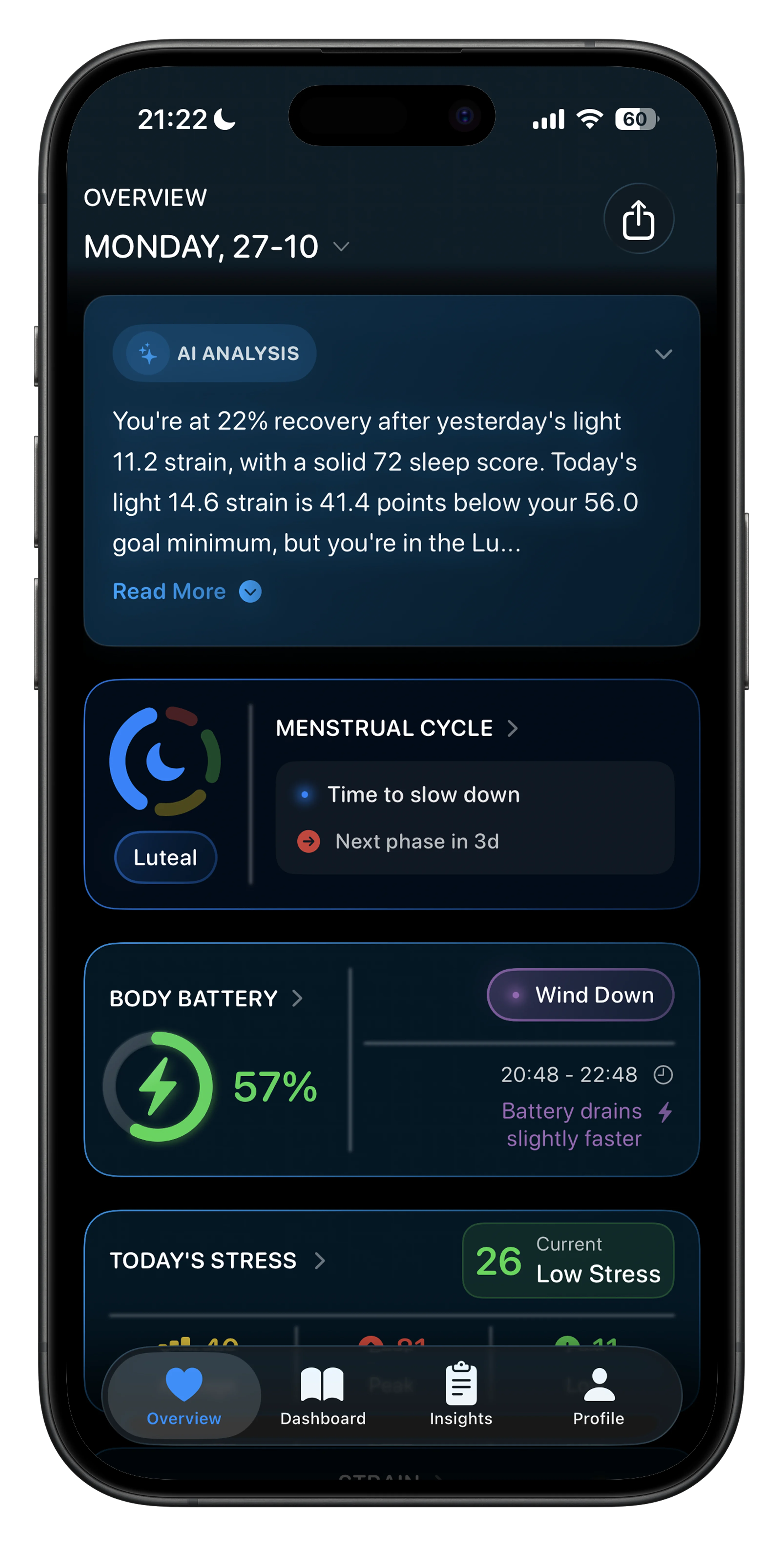 Livity gives you recovery, sleep, and strain insights — right on your iPhone.
WHOOP generated $540 million in revenue in 2023, largely from its subscription model. But the same model that made WHOOP profitable is now driving users away:
- You never own the hardware. Cancel your subscription and the band becomes a paperweight. Your data? Locked behind a paywall.
- It's expensive over time. WHOOP Peak costs $239/year. Over three years, that's over $700 — for a device with no screen.
- Phone dependency. Without a display, you need your phone for every metric. No quick glance at your recovery score.
- Strain tracking has limits. WHOOP calculates strain from heart rate alone, which means it underestimates strength training, yoga, and low-heart-rate activities.
The core features — recovery scores, sleep tracking, HRV monitoring — are no longer exclusive to WHOOP. Your Apple Watch, a smart ring, or even a free app can deliver them.
The Best WHOOP Alternatives in 2026
1. Apple Watch with Native Features (From $249)
With watchOS 11, the Apple Watch quietly became a legitimate WHOOP competitor. Built-in features now include:
- Training Load — analyzes workout volume and compares it to previous weeks
- Vitals app — tracks nightly heart rate, respiratory rate, wrist temperature, and sleep duration with outlier alerts
- Sleep stages — REM, deep, and core sleep tracking
The problem is these features are scattered across multiple apps with no unified dashboard. You won't get a single "recovery score" or "body battery" number. That's where a companion app like Livity fills the gap — it takes all that Apple Watch data and turns it into actionable scores.
Cost: From $249 (Apple Watch SE). No subscription. Best for: People already in the Apple ecosystem who want basic metrics without extra hardware.
📱 Already have an Apple Watch? Livity gives you WHOOP-level recovery, strain, and sleep tracking — free to use, with a 3-day premium trial and no data leaving your device. Try it free →
2. Garmin Watches ($300–$800, No Subscription)
Garmin is the go-to for endurance athletes who want a self-contained tracker. The Venu 3 and Forerunner 265 offer:
- Body Battery — Garmin invented this metric, and it's still one of the best implementations
- Training Readiness — combines HRV, sleep, and recent training load
- Sleep Coach — tells you when and how long to sleep based on your data
- Morning Report — a daily briefing with HRV, sleep quality, and weather
Garmin devices are rugged, have incredible battery life (up to 2 weeks), and never ask for a subscription. The downside: you're buying a whole new device, and the ecosystem can feel overwhelming with dozens of metrics and screens.
Cost: $300–$800 one-time purchase. No subscription. Best for: Runners, cyclists, and triathletes who want a dedicated sports watch.
3. Oura Ring 4 ($349–$499 + $6/month)
The Oura Ring is the sleekest option — a titanium ring that tracks sleep, HRV, temperature, and activity. The Oura Ring 4 improved its sensor accuracy and added daytime HRV readings.
But there's a catch: Oura requires a $6/month subscription to access most insights. Without it, you get bare-bones data. Over three years, you're looking at $560+ in total cost.
Oura excels at sleep tracking and overnight recovery but lacks real-time strain tracking during workouts. It's more of a recovery-first device.
Cost: $349–$499 + $5.99/month subscription. Best for: People who want discreet, 24/7 tracking and prioritize sleep over workout metrics.
4. Livity (Free tier + premium — iPhone + Apple Watch)
If you already own an Apple Watch, Livity is the software layer that turns it into a full WHOOP-style tracker. It reads your Apple Watch sensors and Apple Health data to deliver:
- Recovery score — a daily readiness number based on HRV, resting heart rate, and sleep quality
- Body battery — an energy level tracker that shows how your day is draining (or recharging) you
- Sleep analysis — sleep stages, sleep score, and trends over time
- HRV tracking — nightly HRV with trend analysis and context
- Training load — tracks your exercise strain and warns you about overtraining
- Stress monitoring — real-time stress levels from your Apple Watch
- Fitness age — see how your body compares to your actual age
Unlike WHOOP, Livity is privacy-first — your health data never leaves your device. No account required. No cloud sync. No one sees your data but you.
Cost: Free to install with a 3-day trial of premium features. After the trial, core tracking — sleep, HRV, recovery, body battery — stays free to use forever. Premium unlocks deeper insights, longer trend history, and advanced analytics via a subscription (from €3.45/week). Best for: Apple Watch owners who want WHOOP-level insights without buying new hardware — keep the free tier or upgrade to premium when you're ready.
5. Amazfit Helio Strap ($150, No Subscription)
The Amazfit Helio is the most WHOOP-like alternative hardware-wise: a screen-less strap designed for continuous wear. It tracks recovery, sleep, and workout strain — all without a subscription.
It's significantly cheaper than WHOOP, but the app and data insights aren't as polished. If you want the "invisible band" form factor without the recurring cost, it's worth considering.
Cost: ~$150 one-time purchase. No subscription. Best for: People who specifically want a WHOOP-style strap without the monthly fee.
Total Cost Comparison
Here's what each option actually costs over 3 years:
| Tracker | Year 1 | Year 2 | Year 3 | 3-Year Total |
|---|---|---|---|---|
| WHOOP Peak | $239 | $239 | $239 | $717 |
| Oura Ring 4 | $419 | $72 | $72 | $563 |
| Garmin Venu 3 | $450 | $0 | $0 | $450 |
| Amazfit Helio | $150 | $0 | $0 | $150 |
| Livity + Apple Watch | $0* | $0 | $0 | $0* |
Assumes you already own an Apple Watch. If not, Apple Watch SE starts at $249 — still cheaper than one year of WHOOP + Oura combined.
The $0 column reflects Livity's free tier — core recovery, sleep, HRV, and body-battery tracking with no account and no hardware. Optional premium adds deeper analytics for €3.45/week; you can stay on the free tier as long as you like. Get it on the App Store →
How to Choose the Right Alternative
Choose Livity if you already have an Apple Watch and want WHOOP-style recovery, strain, and sleep tracking for free — with zero data leaving your device.
Choose Garmin if you're a serious endurance athlete who wants a standalone GPS watch with best-in-class battery life.
Choose Oura if you want the most discreet form factor and prioritize sleep tracking above all else (and don't mind the subscription).
Choose the Amazfit Helio if you specifically want a WHOOP-style strap without the monthly fee and don't need the most polished app experience.
Frequently Asked Questions
Is there a free alternative to WHOOP? Yes. If you own an Apple Watch, apps like Livity provide recovery scores, sleep analysis, HRV tracking, body battery, and training load on a free tier — no extra hardware required. A 3-day trial unlocks premium features; after that you can stay on the free tier or subscribe for deeper analytics.
Can Apple Watch replace WHOOP? Apple Watch has the sensors to match WHOOP — optical heart rate, accelerometer, and temperature sensing. What it lacks is a unified recovery dashboard. Companion apps like Livity bridge that gap by analyzing your Apple Watch data and delivering daily recovery and strain scores.
Why is WHOOP so expensive? WHOOP operates on a subscription-only model starting at $239/year. You never own the device — it's included with your membership. When you cancel, the band stops working and your historical data becomes inaccessible without resubscribing.
Is Oura Ring worth it without the subscription? Without the $6/month Oura membership, you only get basic metrics like sleep duration and readiness score. Most detailed insights — HRV trends, sleep stage analysis, personalized recommendations — require the paid tier.
What's the best WHOOP alternative for recovery tracking? For recovery tracking specifically, Livity and Garmin lead the pack. Livity calculates a daily recovery score from your Apple Watch data at no cost. Garmin's Training Readiness and Body Battery scores are among the most respected in the industry.
Start Tracking Recovery Without New Hardware
You don't need to spend $700+ over three years to know if your body is ready to train. Your Apple Watch is already collecting the data — you just need an app that makes sense of it.
Livity turns your Apple Watch into a full recovery, sleep, and fitness tracker — with body battery, HRV trends, training load, stress monitoring, and a daily recovery score. Free to use with a 3-day premium trial; optional subscription for deeper analytics. No Oura Ring, no WHOOP strap, no extra hardware. Your data stays on your device.


iOS developer with 7+ years of experience and an active volleyball player. Built Livity after spending months looking for advanced recovery and sleep tracking that worked natively with Apple Watch — and finding nothing. Uses his own HRV, sleep, and training-load data every day to shape what Livity measures.
More from this authorStart Your Wellness Journey Today
Live Your Best Life
Join thousands of users who are already tracking their health with Livity.