
Garmin Cirqa vs Apple Watch: Do You Need New Hardware?

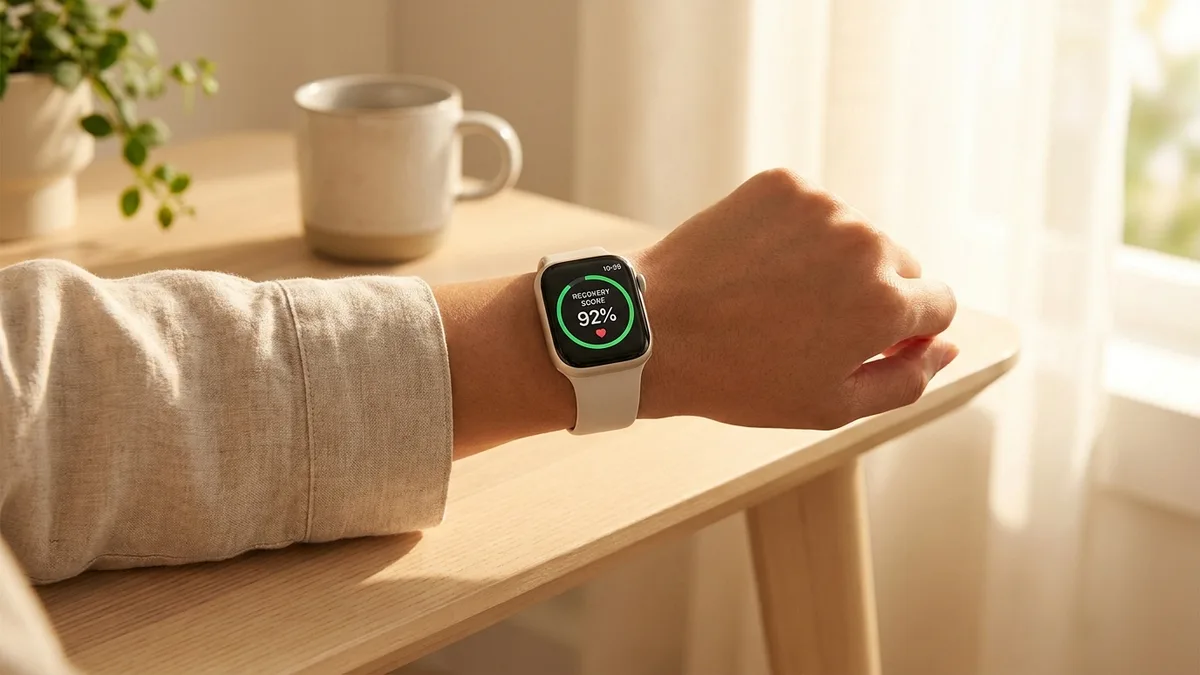
If you've seen the leaks, you're probably asking the same question everyone else is: Garmin Cirqa vs Apple Watch — do you actually need to buy new hardware to get real recovery data, or is the smartwatch already on your wrist good enough? It's a fair question. A screenless health band sounds appealing until you remember you're already wearing sensors that do most of the same job.
We're going to walk through what's rumored about the Cirqa, what your Apple Watch already measures, and where the gap actually is (spoiler: it's mostly software, not hardware).
What Is the Garmin Cirqa, Exactly?
Nothing here is official yet — Garmin hasn't announced the Cirqa as of this writing. But leaks from tech outlets paint a fairly consistent picture. The Cirqa is reportedly a screenless smart health band, positioned to compete directly with Whoop and Fitbit's Ace-style trackers, according to leaked renders and specs reported by The 5K Runner.
Per the leaks, it's said to pack skin temperature and electrodermal activity (EDA) sensors, feeding into a combined "Health Status" metric that folds in heart rate, HRV, respiration rate, skin temperature, and pulse ox according to backend details leaked by Gadgets & Wearables. It's also rumored to be Bluetooth-only — no GPS, no ANT+, no Wi-Fi — meaning it needs your phone nearby to sync data at all.
Pricing leaks point to roughly $199.99 / €199 / £179, with a rumored shipping window of May–June 2026 per the same leaked pricing report. Take all of this as informed speculation, not confirmed specs — Garmin could change anything before launch, or scrap the product entirely.
What Your Apple Watch Already Measures
Here's the thing the Cirqa hype tends to skip past: if you own an Apple Watch, you already have most of the sensor hardware the Cirqa is rumored to ship with.
Apple Watch has an optical heart rate sensor (photoplethysmography, or PPG) that continuously tracks beat-to-beat intervals, which is the same underlying sensor technology used to derive heart rate variability. Studies validating wrist-based PPG heart rate data have found it tracks closely with reference ECG monitoring in real-world settings, as shown in a JMIR Cardio validation study.
It also has a wrist temperature sensor (on Series 8 and later, and Ultra models), an always-on accelerometer and gyroscope, blood oxygen sensing on supported models, and a full sleep-stage tracking pipeline through Apple Health. None of this is new — it's been sitting there, mostly underused, because Apple's own Health app doesn't turn it into a single recovery number the way Whoop or Oura do.
That's the actual gap. It's not sensors. It's the interpretation layer.
Why HRV Matters More Than the Hardware That Measures It
Whatever device you use, the metric doing the heavy lifting behind any "recovery" or "health status" score is almost always heart rate variability. HRV reflects how your autonomic nervous system is balancing stress and recovery, and HRV-guided training approaches have been linked to better cardiac-vagal modulation and endurance outcomes in a systematic review and meta-analysis of the research, summarized in this NIH-hosted review.
The point is: HRV is HRV. Whether it's captured by a Cirqa's EDA and skin temp sensors or an Apple Watch's PPG sensor, the underlying physiological signal is the same. What differs is which company packages it into a score, and whether you have to pay a monthly fee to see it.
Skin temperature, which the Cirqa is rumored to lean on heavily, is also not exclusive to Garmin's hardware — Apple Watch has measured it since Series 8. Nocturnal skin temperature has been studied as a useful signal for tracking physiological cycles, including one ambulatory pilot study using a wearable ring that found consistent temperature shifts tied to hormonal phases, detailed in this BMC Women's Health study. Again: same sensor category, different brand name.
📱 Livity tracks your HRV, sleep, and recovery status straight from your Apple Watch — no new hardware, no extra subscription stacked on top. Try it free →
Garmin Cirqa vs Apple Watch: The Real Trade-Offs
Let's be direct about the actual differences, since "which is better" depends entirely on what you're optimizing for.
Battery and always-on wear. A screenless band is lighter and can likely go longer between charges than an Apple Watch, which matters if you want 24/7 wear without daily charging breaks.
Bluetooth-only limitation. The rumored Cirqa needs your phone nearby to sync, which is a real downside for anyone who leaves their phone at home during a run or gym session — an Apple Watch with cellular doesn't have that constraint.
Cost stacking. At a rumored ~$199, the Cirqa would be an additional purchase on top of whatever smartwatch or phone you already carry. If you already own an Apple Watch, that's redundant hardware spend for overlapping sensors.
Software, not silicon. The actual differentiator between any of these devices — Cirqa, Whoop, Oura, Apple Watch — is the algorithm turning raw sensor data into a score you can act on. That's a software problem, and it's exactly what an app like Livity solves without asking you to buy anything new.
Do You Need a Screenless Fitness Tracker If You Have an Apple Watch?
If you're shopping for your first wearable and specifically want a minimalist, screenless fitness tracker as a Whoop alternative, the Cirqa (once it actually ships) might be worth a look. Some people genuinely prefer not wearing a screen on their wrist.
But if you already own an Apple Watch, adding a second device to get a "Health Status" score is solving a problem you don't have. The sensors are already on your wrist. What's missing is a recovery score app that reads them and gives you a clear daily number — which is a software gap, not a hardware one.
This is also where Apple Watch recovery tracking has quietly caught up. Body battery Apple Watch style scoring — a single number combining sleep, HRV, and strain — used to be something only Garmin or Whoop offered. Now it runs natively off Apple Health data, on-device, without shipping any of your health data to a server.
A Quick Note on Garmin Watches and Apple Health
If you already own a Garmin watch (not the Cirqa, an existing Forerunner or Fenix, for example), you can get some of that data into Apple's Health app through Apple's own bridging support for third-party health platforms. This isn't a Livity feature or a native Garmin sync — it's just Apple Health acting as a shared inbox. Worth knowing, but not a reason to buy a Cirqa if your goal is Apple Watch-based recovery tracking.
FAQ
What is Garmin Cirqa? It's a rumored, unannounced screenless health band from Garmin, leaked to feature skin temperature and EDA sensors feeding a combined "Health Status" score, positioned against Whoop and Fitbit's screenless trackers per leaked details. Nothing about it is confirmed by Garmin as of this writing.
Is Garmin Cirqa better than Whoop? Too early to say — Garmin hasn't confirmed the device, its pricing, or its accuracy. Leaked specs suggest a similar sensor set and scoring concept to Whoop, but real-world comparisons can't happen until it ships, and rumored shipping windows point to mid-2026 according to leaked reporting.
Do I need a Garmin Cirqa if I have an Apple Watch? Probably not. Your Apple Watch already has the optical heart rate sensor, temperature sensor, and motion sensors needed to derive HRV-based recovery scoring. The missing piece is usually an app that interprets that data, not new hardware.
Does Livity work with Garmin watches? No — Livity does not have a native Garmin Connect integration and doesn't sync directly with Garmin devices. Livity is built for Apple Watch and Apple Health only. If you own a Garmin watch, some data can reach Apple Health through Apple's own third-party bridging, but that's not a Livity feature, and Livity's scoring is designed around Apple Watch sensor data specifically.
Is a screenless fitness tracker worth buying if I already track sleep and HRV with an app? For most Apple Watch owners, no — a second device with overlapping sensors adds cost and another thing to charge without adding new physiological signal, since the underlying HRV and temperature data is already available through the watch you own.
Start Tracking Your Recovery Today
You don't need to wait for a rumored device to ship, or spend €199 on hardware that duplicates sensors you already own. Livity turns the Apple Watch you already own into a private, on-device recovery score — no new hardware, no extra subscription.
Sources
- Heart Rate Variability-Guided Training for Enhancing Cardiac-Vagal Modulation, Aerobic Fitness, and Endurance Performance: A Methodological Systematic Review with Meta-Analysis — International Journal of Environmental Research and Public Health (NIH/PMC), 2021
- Validation of Heart Rate Extracted From Wrist-Based Photoplethysmography in the Perioperative Setting: Prospective Observational Study — JMIR Cardio, 2021
- Nocturnal finger skin temperature in menstrual cycle tracking: ambulatory pilot study using a wearable Oura ring — BMC Women's Health (NIH/PMC), 2019
- Garmin Cirqa price and backend details leaked — Gadgets & Wearables, 2026
- 2 Garmin Cirqa images leaked — The 5K Runner, 2026

iOS developer with 7+ years of experience and an active volleyball player. Built Livity after spending months looking for advanced recovery and sleep tracking that worked natively with Apple Watch — and finding nothing. Uses his own HRV, sleep, and training-load data every day to shape what Livity measures.
More from this authorStart Your Wellness Journey Today
Live Your Best Life
Join thousands of users who are already tracking their health with Livity.