
VO2 Max and Fitness Age Explained: What Your Apple Watch Is Really Telling You

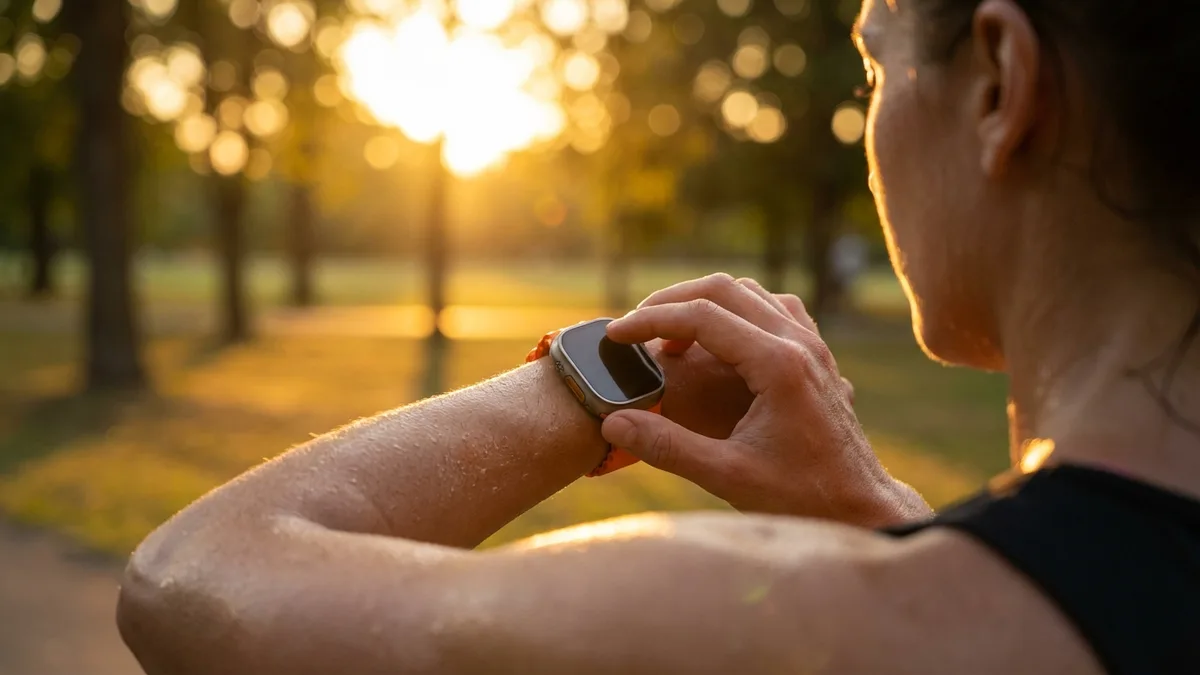
Your Apple Watch quietly tracks a number that research says is the strongest predictor of how long you'll live. It's not your heart rate. It's not your step count. It's your VO2 max — and most people have never looked at it.
A landmark study from the Cleveland Clinic followed over 122,000 people and found that low cardiorespiratory fitness was a stronger risk factor for death than smoking, diabetes, or heart disease. The people with the highest VO2 max had an 80% lower risk of dying during the study compared to the least fit group.
That's not a typo. Your cardio fitness level matters more than almost any other health metric.
What Is VO2 Max?
VO2 max stands for maximal oxygen uptake — the maximum amount of oxygen your body can use during intense exercise, measured in millilitres per kilogram of body weight per minute (ml/kg/min).
Think of it like this: your muscles need oxygen to produce energy. The more oxygen your body can deliver and use, the harder and longer you can work. VO2 max is the ceiling of your aerobic engine.
A higher VO2 max means your heart pumps more blood per beat, your lungs exchange gas more efficiently, and your muscles extract more oxygen from your bloodstream. It's a full-body fitness score rolled into one number.
The gold standard for measuring VO2 max is a lab test where you run on a treadmill with a mask that measures oxygen consumption while the intensity gradually increases until you can't continue. But you don't need a lab — your Apple Watch estimates it using heart rate, GPS pace, and motion data, with studies showing accuracy within about 6 ml/kg/min of lab values.
What Is a Good VO2 Max by Age?
VO2 max naturally declines with age — roughly 10% per decade after your mid-twenties. But the rate of decline depends heavily on how active you stay. Master athletes who keep training lose only about 5.5% per decade, while sedentary people lose 12% or more.
Here's what the numbers look like:
Men (ml/kg/min)
| Age | Poor | Fair | Good | Excellent | Superior |
|---|---|---|---|---|---|
| 20–29 | <42 | 42–45 | 45–51 | 51–55 | 55+ |
| 30–39 | <41 | 41–44 | 44–48 | 48–54 | 54+ |
| 40–49 | <39 | 39–42 | 42–46 | 46–53 | 53+ |
| 50–59 | <36 | 36–39 | 39–43 | 43–49 | 49+ |
| 60–69 | <32 | 32–36 | 36–40 | 40–46 | 46+ |
Women (ml/kg/min)
| Age | Poor | Fair | Good | Excellent | Superior |
|---|---|---|---|---|---|
| 20–29 | <36 | 36–40 | 40–44 | 44–50 | 50+ |
| 30–39 | <34 | 34–38 | 38–42 | 42–47 | 47+ |
| 40–49 | <33 | 33–36 | 36–40 | 40–45 | 45+ |
| 50–59 | <30 | 30–33 | 33–37 | 37–41 | 41+ |
| 60–69 | <28 | 28–30 | 30–33 | 33–38 | 38+ |
For context, the average untrained male sits around 35–40 ml/kg/min, and the average untrained female around 27–31 ml/kg/min. Elite endurance athletes can reach 80+ ml/kg/min.
The minimum threshold for maintaining independence as you age is about 18–20 ml/kg/min. Below that, everyday tasks like climbing stairs or carrying groceries become genuinely difficult. That's why building a buffer now matters so much.
VO2 Max and Longevity: The Research

The connection between VO2 max and lifespan isn't a loose correlation — it's one of the strongest associations in exercise science.
The Cleveland Clinic Study (2018)
Published in JAMA Network Open (Mandsager et al., 2018), this study tracked 122,007 patients over a median of 8.4 years. The results were striking:
- People with elite fitness had an 80% lower mortality risk compared to the least fit
- Low fitness carried a higher death risk than smoking, diabetes, or coronary artery disease
- There was no upper limit to the benefit — even going from "high" to "elite" fitness still reduced mortality
- Death rates by group: Low 23.7%, Below average 10.6%, Above average 7.3%, High 4.7%, Elite 2.6%
The Veterans Study (2022)
A study of 750,000+ U.S. veterans published in JACC (Kokkinos et al., 2022) found that each 1-MET increase (roughly 3.5 ml/kg/min of VO2 max) was associated with roughly a 14% reduction in mortality risk — consistent across age, sex, and race.
What the Numbers Mean for You
Dr. Peter Attia, a physician focused on longevity medicine, calls VO2 max "the most powerful independent predictor of all-cause mortality." His analysis of the data shows:
- Moving from the bottom 25% to the 25th–50th percentile cuts your mortality risk by roughly 50%
- Moving from the bottom 25% to above average cuts it by 70%
- Every 1 ml/kg/min increase is associated with approximately 45 extra days of life
The takeaway: even modest improvements in VO2 max have an outsized impact on how long — and how well — you live.
Livity tracks your VO2 max and fitness age automatically from your Apple Watch — no extra hardware, no subscription. Try it free →
What Is Fitness Age?
Your fitness age is a simpler way to understand your VO2 max: it's the age at which your current VO2 max would be considered average.
The concept was developed by researchers at the Norwegian University of Science and Technology (NTNU) CERG group based on data from the HUNT Fitness Study — one of the largest health studies ever conducted. They followed tens of thousands of people and validated that fitness age predicts mortality better than chronological age.
Here's how it works:
- A 45-year-old man with a VO2 max of 48 ml/kg/min has the aerobic fitness of an average 30-year-old. His fitness age: 30.
- A 35-year-old woman with a VO2 max of 30 ml/kg/min has the aerobic fitness of an average 55-year-old. Her fitness age: 55.
The formula accounts for your actual age, sex, and VO2 max relative to population norms. A fitness age lower than your chronological age is associated with longer life expectancy. A fitness age higher than your chronological age is a signal to prioritise your cardiovascular fitness.
Your Apple Watch shows this as your "Cardio Fitness" level in the Health app. Livity takes it further by tracking your fitness age over time and showing how your training affects it week by week.
How to Improve Your VO2 Max

The good news: VO2 max is highly trainable. Most people can improve theirs by 5–10% within 60–90 days with the right approach. Even people over 60 can make significant gains.
Research consistently points to two pillars:
1. Zone 2 Training (The Base)
Zone 2 is a comfortable, conversational pace — you can talk but not sing. This trains your heart to pump more blood per beat and your muscles to use oxygen more efficiently.
- Duration: 30–45 minutes per session
- Frequency: 2–3 times per week
- Activities: Brisk walking, easy jogging, cycling, swimming
- Heart rate: Roughly 60–70% of your max heart rate
Zone 2 should make up the majority of your training volume. It builds the aerobic foundation that makes high-intensity work possible.
2. High-Intensity Intervals (The Ceiling Raiser)
To push your VO2 max higher, you need to spend time near it. High-intensity intervals force your cardiovascular system to operate at maximum capacity.
The most studied protocol is the Norwegian 4x4 method:
- Warm up for 10 minutes
- Go hard for 4 minutes at 90–95% of your max heart rate
- Recover at easy pace for 4 minutes
- Repeat 4–6 times
- Cool down for 5 minutes
The endurance-training literature converges on 3–5 minute intervals at high intensity as most effective for pushing VO2 max upward — the Norwegian 4x4 protocol above sits right in that window. Shorter intervals (like 30-second sprints) build power and anaerobic capacity but don't push the aerobic ceiling as effectively.
- Frequency: 1–2 times per week (don't overdo it — recovery matters)
- Progression: Start with 3 rounds and build to 5–6 over several weeks
Other Factors
- Body composition: Losing excess body fat increases your relative VO2 max (since it's measured per kg of body weight)
- Consistency: Three months of consistent training beats one month of aggressive training
- Recovery: Overtraining tanks your VO2 max. Monitor your HRV and recovery to know when to push and when to rest
How Accurate Is Apple Watch VO2 Max?
Your Apple Watch estimates VO2 max using a combination of heart rate data, GPS pace, accelerometer data, and your personal details (age, sex, weight, height). Apple uses a deep neural network trained on their own validation data.
What the studies say:
- Apple's internal validation (755 participants) found accuracy within 1.2–1.4 ml/kg/min (~4% error)
- Independent validation work shows wider variation — published comparisons report the Apple Watch can underestimate VO2 max by several ml/kg/min versus lab testing, with error rates in the low teens percent
- Accuracy improves for fitter individuals and during outdoor workouts with GPS
Bottom line: Apple Watch VO2 max is good for tracking trends over time — it reliably shows whether your fitness is improving, declining, or holding steady. It's less reliable for pinpointing your exact VO2 max compared to a lab test. But the trend is what matters for health decisions.
For best results:
- Do outdoor walks, runs, or hikes of 20+ minutes regularly
- Keep your health profile updated (weight, height)
- Wear your watch snugly during workouts
- Look at the trend over weeks and months, not individual readings
FAQ
What is a good VO2 max for a 40-year-old?
For men aged 40–49, a VO2 max of 42–46 ml/kg/min is considered "Good" and 46–53 is "Excellent." For women, 36–40 is "Good" and 40–45 is "Excellent." Aim for at least the "Good" range to build a solid longevity buffer.
Can you improve VO2 max after 50?
Yes. Studies show people over 60 can still improve VO2 max by 10–15% with consistent training. The rate of improvement may be slightly slower than in younger adults, but the health benefits are just as significant — possibly more so.
How often should I test my VO2 max?
If you're using an Apple Watch, you don't need to "test" it — it updates automatically based on your outdoor workouts. Check your trend monthly. If you're doing lab testing, every 3–6 months is reasonable during active training.
Is VO2 max more important than strength training?
Both matter. VO2 max is the strongest predictor of longevity among fitness metrics, but muscle mass and strength also decline with age and are independently linked to mortality risk. The ideal approach is a combination of cardio training (for VO2 max) and resistance training (for muscle and bone health).
Why is my Apple Watch VO2 max going down even though I'm training?
Common causes: overtraining without enough recovery, illness or stress, weight gain, not doing enough outdoor workouts for your watch to measure properly, or training at too low an intensity. If your HRV is also dropping, you may need more rest days. If your HRV is fine, try adding one high-intensity session per week.
Start Tracking Your Fitness Age Today
Your VO2 max tells you more about your long-term health than almost any other number. The research is clear: improving it — even modestly — is one of the most impactful things you can do for your lifespan and quality of life.
Livity tracks your VO2 max, fitness age, and recovery automatically from your Apple Watch — no Oura Ring, no Whoop strap, no extra hardware. See your fitness age trend over time and know whether your training is actually making a difference. Free to try on the App Store.
Sources
- Association of Cardiorespiratory Fitness With Long-term Mortality Among Adults Undergoing Exercise Treadmill Testing — JAMA Network Open, 2018
- HUNT Fitness Study — CERG, NTNU (fitness age methodology) — Norwegian University of Science and Technology, 2013
- Predicting VO2peak from Submaximal- and Peak Exercise Models: The HUNT 3 Fitness Study — PLOS One, 2016

iOS developer with 7+ years of experience and an active volleyball player. Built Livity after spending months looking for advanced recovery and sleep tracking that worked natively with Apple Watch — and finding nothing. Uses his own HRV, sleep, and training-load data every day to shape what Livity measures.
More from this authorStart Your Wellness Journey Today
Live Your Best Life
Join thousands of users who are already tracking their health with Livity.