
Orthosomnia: Is Your Sleep Tracker Actually Making Your Sleep Worse?

You wake up, reach for your wrist, and check the number. A 62. Your stomach drops. You slept for seven hours, felt fine until ten seconds ago, and now you're convinced the day is ruined. Sound familiar?
If checking your sleep score has become a morning anxiety ritual, you're not alone — and there's actually a name for it. Orthosomnia is the growing phenomenon where the very technology designed to improve your sleep ends up making it worse.
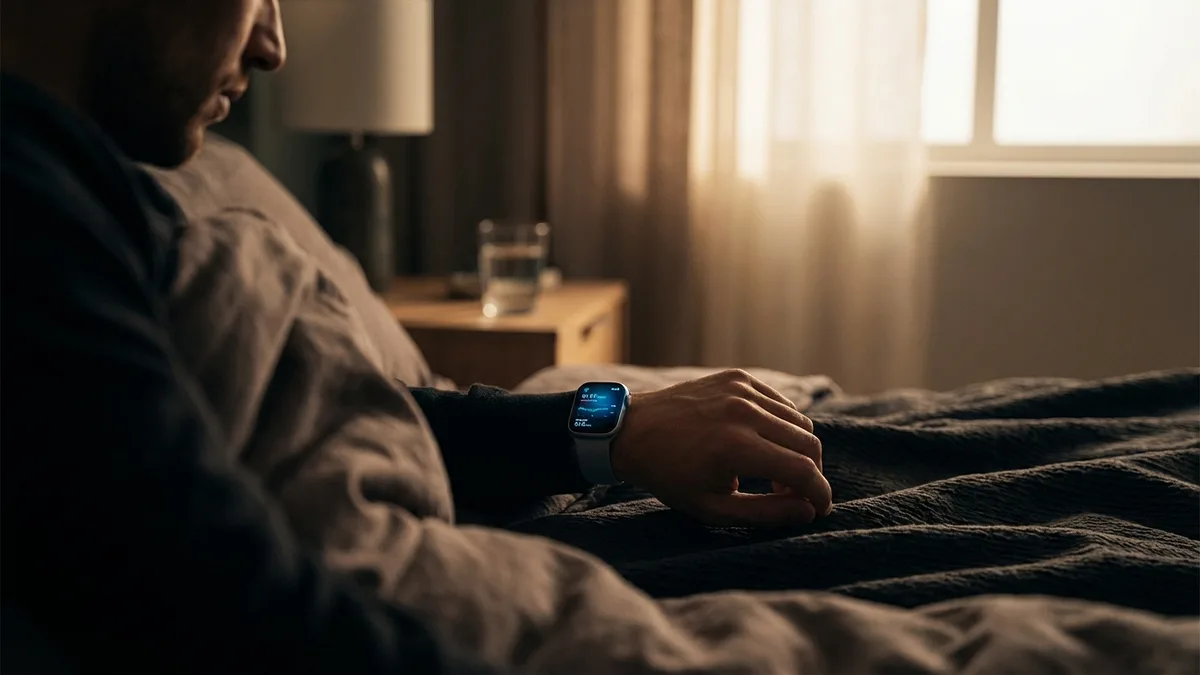 When the urge to check your sleep score keeps you awake, the tracker has become part of the problem.
What Is Orthosomnia?
Orthosomnia comes from the Latin ortho (correct) and somnia (sleep). It describes an unhealthy preoccupation with achieving "perfect" sleep, driven by data from wearable sleep trackers.
The term was coined in a 2017 paper in the Journal of Clinical Sleep Medicine by clinical psychologist Kelly Baron and her colleagues at Rush University Medical Center. They described patients insisting their sleep was terrible — not because of how they felt, but because of what their tracker told them. Some patients refused to accept reassurance from clinicians, trusting their device over a sleep specialist.
Orthosomnia isn't a formal medical diagnosis yet. But research on it is accelerating, and the pattern is clear: when you fixate on optimizing a number, sleep stops being restful and starts being a performance you're grading yourself on.
The Research: How Common Is This?
The numbers are bigger than you'd expect.
A 2024 cross-sectional study in Brain Sciences surveyed 523 adults and found the prevalence of orthosomnia ranged from 3% to 14% depending on how strictly it was defined. 35.8% of participants owned and regularly used a sleep-tracking wearable, and those identified with orthosomnia consistently had higher insomnia scores than non-cases — tracker-related anxiety was directly linked to worse sleep.
The age gap is striking. TIME's 2025 reporting on sleep anxiety cites survey data showing roughly 23% of users aged 18 to 35 said sleep apps made them stressed about their sleep, versus just 2.4% among those 66 and older. Young adults — the generation most likely to wear a smartwatch to bed — are nearly ten times more likely to develop sleep tracker anxiety.
Signs You Might Have Orthosomnia
Not sure if your tracking habit has crossed a line? Here are the warning signs sleep researchers have identified:
- Your morning mood depends on your sleep score. You felt rested until you saw the number — then suddenly you didn't.
- You check your data in the middle of the night. Waking up and immediately looking at your tracker to see how much sleep you've logged so far.
- You feel anxious if you can't track your sleep. Forgot your watch? Dead battery? The idea of an untracked night feels unsettling.
- You've made drastic lifestyle changes based on tracker data alone — not how you actually feel.
- You spend more time researching sleep optimization than you spend on the wind-down routine that would actually help.
- You trust your device over your own body. If your tracker says you slept poorly, you believe it — even when you woke up feeling fine.
The core issue is a disconnect: you stop listening to how you feel and start outsourcing that judgment to an algorithm. Consumer sleep trackers measure movement and heart rate — they're useful tools, but they're not polysomnography. They estimate. They approximate. They can be wrong.
📱 Livity tracks your sleep and recovery from your Apple Watch — with no social feeds, no streaks, and no pressure. Just your data, on your device. Try it free →
Why Sleep Trackers Can Backfire
 Healthy sleep tracking means the data serves you — not the other way around.
Sleep trackers aren't inherently bad. The problem is how we relate to the data. Here's what goes wrong:
The Anxiety Feedback Loop
You get a low sleep score. That makes you anxious. Anxiety makes it harder to fall asleep the next night. You get another low score. The loop tightens.
This is exactly what researchers describe as performance anxiety applied to sleep. The harder you try to sleep well, the more elusive good sleep becomes. It's the same reason telling someone "just relax" has never worked in the history of human communication.
Accuracy Isn't Perfect
Consumer wearables track sleep using accelerometry and optical heart rate sensors. They're reasonably good at detecting when you're asleep versus awake, but they struggle with accurately staging sleep (light, deep, REM). A 2024 review found that most consumer devices overestimate total sleep time and misclassify sleep stages compared to clinical polysomnography.
So when your tracker says you only got 12 minutes of deep sleep? Take that with a grain of salt. You might be anxious about a measurement error.
The "Sleepmaxxing" Trap
Social media has turned sleep into a competitive sport. Optimizing every variable — supplements, mouth tape, cooling mattress pads, blue-light blockers stacked three deep — can create a rigid, high-pressure bedtime routine that's the opposite of relaxing. The American Academy of Sleep Medicine has noted that "sleepmaxxing" trends are changing bedtime behaviors and, for some people, keeping them awake at night.
How to Track Sleep Without Losing Sleep
The goal isn't to throw your Apple Watch in a drawer. Sleep data can be genuinely useful — when you use it the right way.
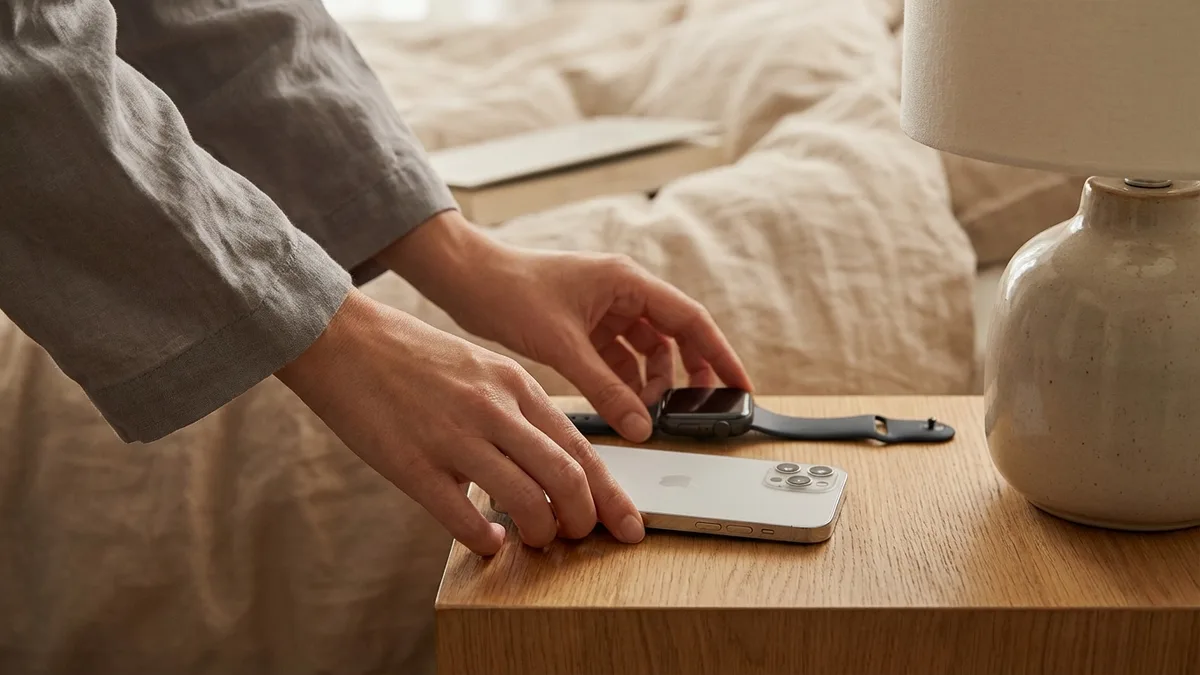 Setting digital boundaries at bedtime is one of the simplest things you can do for better sleep.
1. Look at Trends, Not Single Nights
One bad night means nothing. A week of bad nights might mean something. Zoom out. Weekly and monthly averages are far more meaningful than any single score. Your sleep naturally varies — that's normal, not a crisis.
2. Check Your Data Later, Not Immediately
Resist the urge to check your score the moment you wake up. Give yourself 30 minutes to notice how you actually feel first. Your subjective sense of restfulness matters more than any algorithm's opinion. If you felt good, you slept well enough — regardless of what the number says.
3. Set Boundaries With Notifications
Turn off sleep-related push notifications. You don't need your phone telling you that you "missed your sleep goal" at 7 AM. Choose when you engage with your data on your own terms.
4. Take Tracker Breaks
Try going a week without checking your sleep data. Wear the watch if you want (the data will still be there), but don't look at it. Notice whether your sleep anxiety decreases. Many people find that a short break resets their relationship with tracking.
5. Choose a Tracker That Respects Your Peace
Not all sleep apps are designed the same way. Some use streaks, social comparisons, and push notifications to keep you engaged — features that can feed orthosomnia. Look for tools that give you data without pressure, keep things private, and let you check in on your own schedule.
6. Focus on What You Can Control
Instead of obsessing over your sleep score, put your energy into the basics that actually improve sleep: consistent bed and wake times, a cool and dark bedroom, limiting caffeine after noon, and a wind-down routine that helps your nervous system shift gears.
Frequently Asked Questions
Is orthosomnia a real medical condition?
Orthosomnia is not yet a formally recognized medical diagnosis in the DSM or ICD. It's a term coined by sleep researchers in 2017 to describe a pattern they were increasingly seeing in clinical practice: patients whose sleep worsened because of their fixation on tracker data. While it lacks an official diagnostic code, the phenomenon is well-documented in peer-reviewed research and is taken seriously by sleep medicine professionals.
Can a sleep tracker actually cause insomnia?
Yes, indirectly. The tracker itself doesn't cause insomnia, but the anxiety and hypervigilance that come from obsessing over its data can. Stress and worry about sleep are well-established triggers for insomnia. If you lie in bed worrying about whether you'll hit your sleep goal, you've created exactly the kind of arousal state that prevents sleep.
How accurate are consumer sleep trackers?
Consumer wearables like Apple Watch are reasonably accurate at detecting sleep versus wake (around 85-95% agreement with polysomnography). However, they're significantly less reliable at classifying individual sleep stages. Deep sleep and REM measurements can be off by a wide margin. Use stage data as a rough guide, not gospel.
Should I stop using my sleep tracker if I have orthosomnia?
Not necessarily. The goal is to change your relationship with the data, not to abandon tracking entirely. Try checking your data less frequently, focusing on weekly trends instead of nightly scores, and prioritizing how you feel over what the number says. If those steps don't help and sleep anxiety persists, taking a break or talking to a sleep specialist is a good next step.
Who is most at risk for orthosomnia?
Research suggests that younger adults (18-35) are significantly more susceptible, with about 23% reporting tracker-induced sleep stress compared to just 2.4% of adults over 66. People who are already prone to anxiety, perfectionism, or health-related worry may also be at higher risk. The more emotionally invested you are in the data, the more vulnerable you are.
Track Your Sleep Without the Anxiety
Livity was designed for people who want sleep insights without the obsession. Your data stays on your device, there are no leaderboards, and no one's judging your sleep score.
Livity tracks your sleep, recovery, and HRV automatically from your Apple Watch — no extra hardware, no social pressure. Free to try on the App Store.
Sources
- Orthosomnia: Are Some Patients Taking the Quantified Self Too Far? — Journal of Clinical Sleep Medicine, 2017
- Prevalence of Orthosomnia in a General Population Sample: A Cross-Sectional Study — Brain Sciences, 2024
- Your Quest for Perfect Sleep Is Keeping You Awake — TIME, 2025

iOS developer with 7+ years of experience and an active volleyball player. Built Livity after spending months looking for advanced recovery and sleep tracking that worked natively with Apple Watch — and finding nothing. Uses his own HRV, sleep, and training-load data every day to shape what Livity measures.
More from this authorStart Your Wellness Journey Today
Live Your Best Life
Join thousands of users who are already tracking their health with Livity.