
Which Heart Calculation Method Should I Pick?
Last updated: February 19, 2026
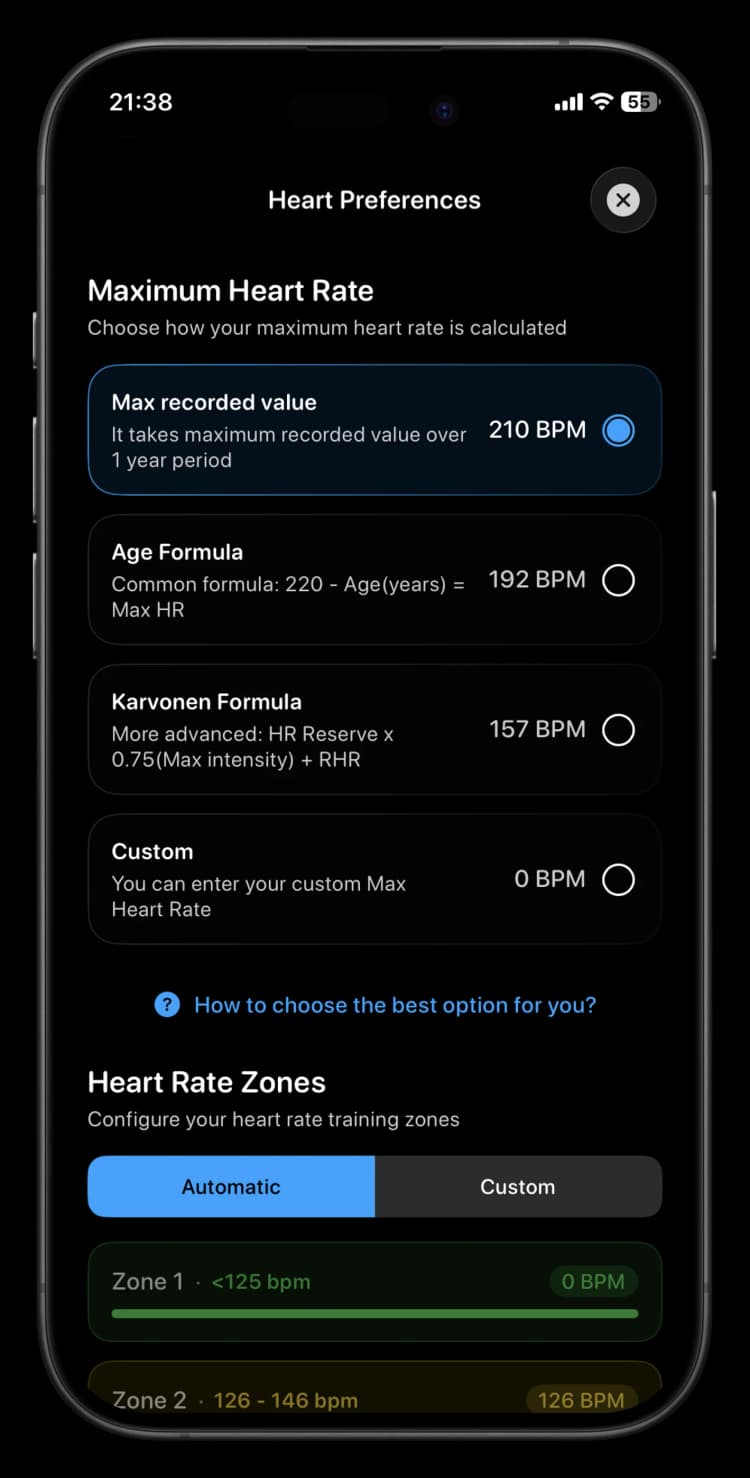
The Livity app separates heart rate personalization into two distinct concepts: how your maximum heart rate is determined, and how your training zones are calculated from that value. Understanding both helps you get the most accurate and meaningful heart rate zones.
Two Key Concepts
Livity uses two separate settings to personalize your heart rate zones: your maximum heart rate source and your zone calculation method. You can combine any max HR source with any zone calculation method to suit your training goals.
How to Determine Your Maximum Heart Rate
Your maximum heart rate (Max HR) is the foundation for all zone calculations. Livity offers three ways to determine it.
Measured Max
Uses your highest sustained heart rate recorded from Apple Watch workouts as your maximum heart rate.
Advantages
- •Based on real physiological data
- •Updates automatically with new peak performances
- •Reflects your actual exertion levels
Limitations
- •Requires high-intensity workouts to capture true maximum
- •Dependent on device accuracy
- •May underestimate true maximum if you have not trained at full intensity
Age Formula (Tanaka)
Uses the Tanaka formula — a scientifically validated equation developed in 2001 — to estimate your maximum heart rate based on your age. This is more accurate than the traditional 220 - age formula, especially for older adults.
Max HR = 208 - (0.7 × Age)
Advantages
- •Simple and requires no additional measurement
- •Based on a large, diverse dataset
- •More accurate than the traditional 220 - age formula
Limitations
- •Still an estimate — individual variation exists
- •Does not account for fitness level or training history
- •May differ significantly from your actual maximum
Custom Max Heart Rate
Manually enter a known maximum heart rate — for example from a clinical test, a coached workout, or a verified personal best effort.
Advantages
- •Most accurate when based on a verified measurement
- •Can incorporate results from professional or clinical testing
- •Fully adaptable to your individual physiology
Limitations
- •May require professional or lab-based testing for best accuracy
- •Needs to be updated as your fitness changes
- •Incorrect input will affect all zone calculations
How to Calculate Training Zones
Once your maximum heart rate is established, Livity offers three methods to calculate your training zones.
% of Max
Calculates training zones as simple percentages of your maximum heart rate. This is the most straightforward zone calculation method.
Zone HR = Max HR × %
Advantages
- •Simple and easy to understand
- •Widely used in training literature and guides
- •Consistent and predictable zone boundaries
Limitations
- •Does not account for resting heart rate
- •May be less precise for highly trained athletes
- •Does not adapt to changes in cardiovascular fitness
HRR (Heart Rate Reserve)
Uses the Karvonen method, which factors in your resting heart rate to provide more individualized zones. This is the same method used by Apple for their heart rate zones.
Target HR = ((Max HR - Resting HR) × Intensity%) + Resting HR
Advantages
- •Accounts for resting heart rate and cardiovascular fitness
- •Provides more personalized zone boundaries
- •Adapts as your resting heart rate improves with training
Limitations
- •Requires accurate resting heart rate measurement
- •Slightly more complex than percentage-of-max
- •Resting HR must be updated periodically for best accuracy
Custom Zones
Manually set each zone threshold. Ideal for athletes who have had their zones determined through professional testing such as lactate threshold testing.
Advantages
- •Fully customizable to your specific physiology
- •Can use data from professional or clinical assessments
- •Most precise option when based on verified measurements
Limitations
- •Requires professional testing for best results
- •Needs periodic reassessment as fitness changes
- •Incorrect values will skew all zone calculations
Recommendations Based on Fitness Level
For Beginners and General Fitness
Start with the Age Formula (Tanaka) for your max HR and the Heart Rate Reserve method for zone calculation. The HRR method accounts for your resting heart rate, making it especially useful for tracking cardiovascular improvement as you train.
For Competitive Athletes
Use a measured or custom max HR combined with Custom Zones based on lactate threshold testing (LTHR). This gives you the most precise zone boundaries for structured training and performance optimization.
For Rehabilitation and Special Populations
The Measured Max method combined with Percentage of Max zones provides a conservative and data-driven approach. It helps prevent overexertion while allowing gradual, safe progression in activity levels.
Important Note
This guide is for informational purposes only and should not replace professional medical advice. For more detailed information, refer to the American Heart Association's guidelines on target heart rates.